-
WhatsApp +86 15116118247
-
Any Questions info@terrahats.com
Why Printed Under-Brims Require Sample Approval
See why printed under-brims require physical sample approval for scale, crop, color, attachment and edge finishing.

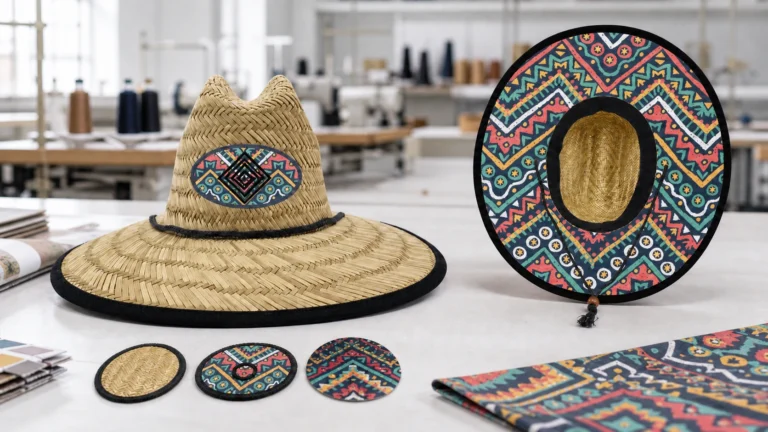
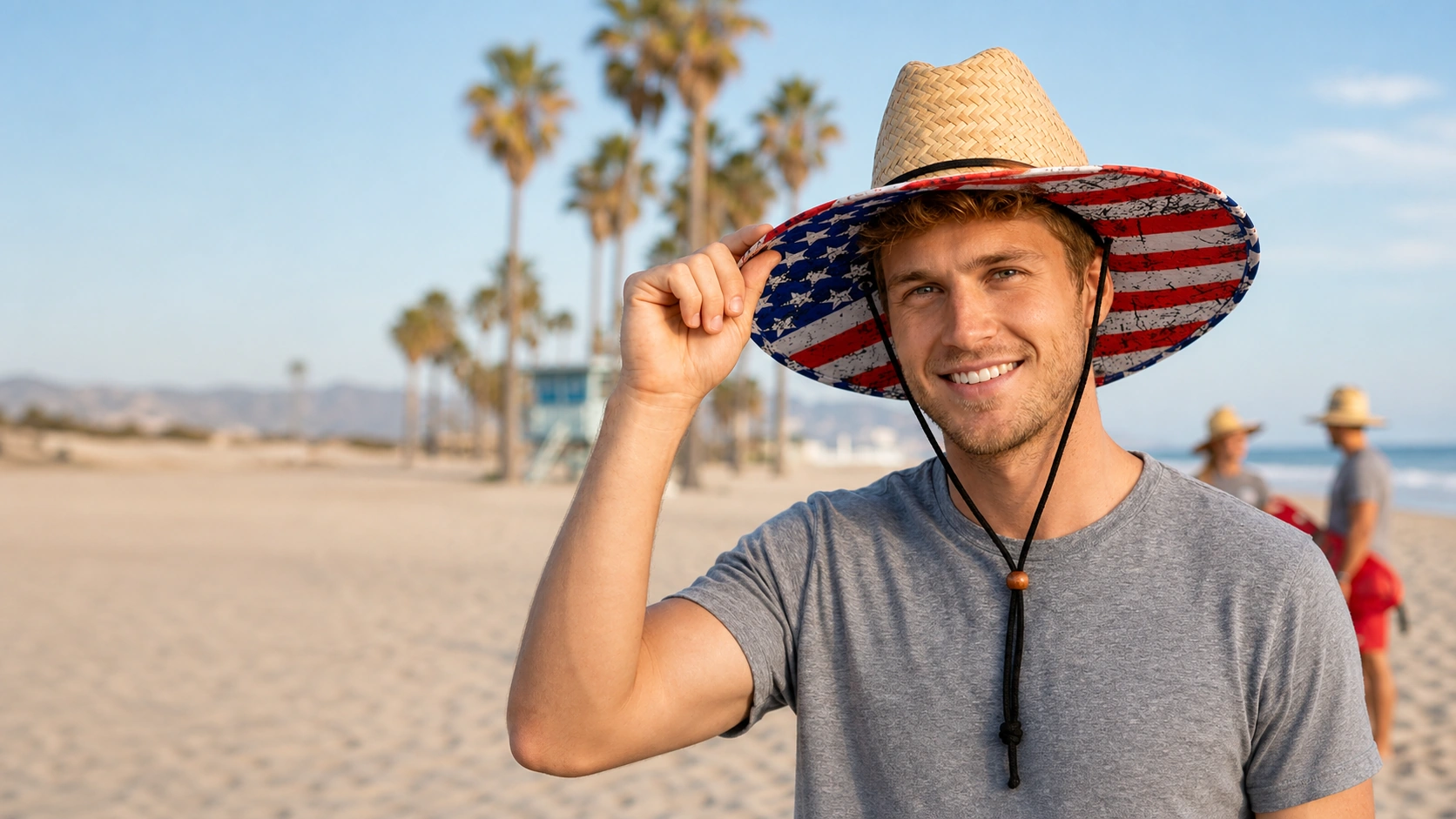
A custom printed under-brim can turn the underside of a lifeguard straw hat into a large secondary branding surface. It may carry a repeat pattern, campaign graphic, resort motif or color system designed to appear when the wearer tilts the brim.
But the artwork file shows only the intended graphic. It does not show exactly how that graphic will look after it is scaled, cropped, printed on the selected material, positioned beneath a three-dimensional brim, attached and finished at the edge.
That gap is why a production-representative physical sample should become an approval gate before bulk release.
Here, “require” describes a prudent buyer-and-supplier production process, not a universal legal requirement. The approval question is not simply, “Is the correct artwork under the brim?” It is:
Does the artwork, material and finished brim construction create the intended result on the actual hat?
A reliable approval process separates the digital mockup from the physical sample, then records decisions about repeat, scale, crop, alignment, color, material, attachment and edge binding.
Table of Contents
Quick Answer: Why Is a Physical Under-Brim Sample Necessary?
A digital mockup can help approve the artwork version, intended orientation, approximate scale and general coverage. It cannot fully confirm:
- How large the pattern appears on the finished brim
- Which parts of the design will be cut away or concealed
- Whether the repeat creates awkward clusters or gaps
- How the artwork aligns with the front, back and sides of the hat
- How the printed color appears on the selected material
- Whether a backing or extra layer changes opacity, flexibility or hand feel
- How seams or attachment lines affect the visible design
- How edge binding changes the artwork boundary
- Whether the result looks balanced when the hat is worn
The physical sample brings these variables together. It gives the buyer, product developer and supplier one tangible reference for the intended result.
It does not guarantee that every bulk unit will be visually identical or replace bulk quality control. It reduces ambiguity by establishing a controlled reference for the approved under-brim design and construction.
Digital Mockup vs. Physical Sample
A mockup and a physical sample answer different questions.
| Approval tool | What it can help confirm | What it cannot fully confirm |
|---|---|---|
| Artwork file | Design content, repeat construction, color references and file version | Finished size, physical color, attachment or edge result |
| Digital mockup | General placement, approximate scale, orientation and visual direction | Final crop, material response, formed-brim alignment or finished construction |
| Printed material test | Print clarity and color direction on the proposed material | Complete brim shape, attachment, binding or worn view |
| Physical hat sample | Scale, crop, alignment, material, color, attachment, binding and combined appearance | Unapproved changes or identical appearance across every bulk unit |
| Written specification | Artwork version, material, construction and approval scope | The full visual and tactile result without a physical reference |
A mockup is useful early because artwork changes are easier to discuss before physical development. It may reveal that a pattern is too busy, too sparse or incorrectly oriented.
However, a flat graphic on a screen is not the same as a finished brim. The brim has thickness, curvature, an outer edge, a crown opening and construction details that determine what remains visible. Mockup approval should therefore mean “proceed with this visual direction,” not “the finished under-brim is approved.”
The TerraHats sample policy can be used to define which physical details must be reviewed before production release.
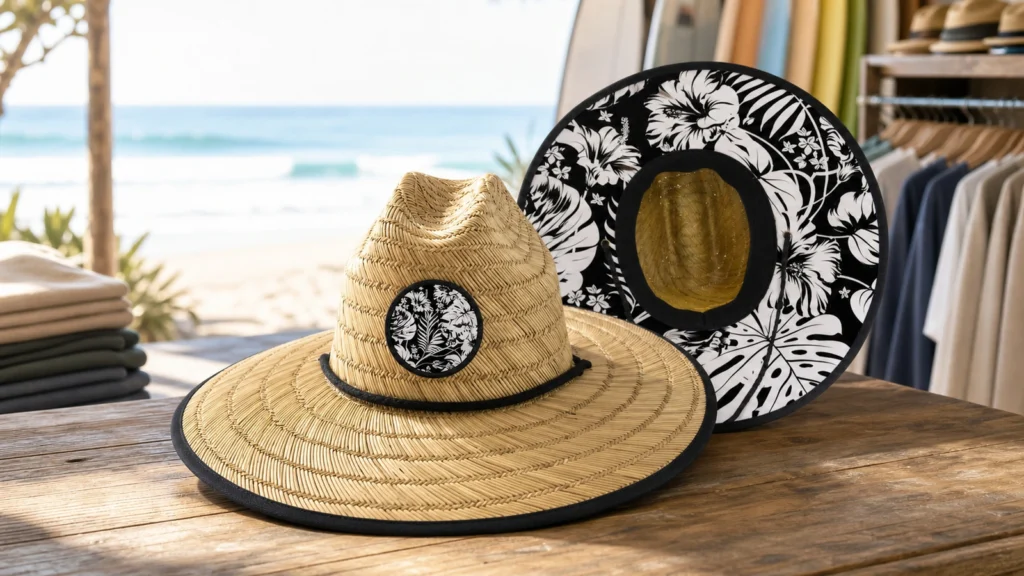
Control the Artwork Layout: Repeat, Scale, Crop and Alignment
Key takeaway: Approve the artwork as a full under-brim layout, not as an isolated motif shown at an arbitrary screen size.
Build the Repeat Across the Complete Brim
A repeat pattern must be evaluated as a system, not only as one attractive motif.
The production artwork should identify:
- The repeat tile or full-placement design
- The intended repeat direction
- Top, bottom, left and right orientation
- Any element that must face the wearer or viewer
- The artwork version and issue date
- Color references
- Elements that must remain fully visible
- Areas where cropping is acceptable
A seamless repeat can reduce the visual impact of tile joins, but “seamless” in the file does not automatically mean balanced on the hat. A motif may repeat correctly and still create an unintended cluster, gap or partial logo once it is fitted around the crown opening and outer brim.
If the design includes text, directional icons or recognizable brand marks, orientation needs particular attention. Some elements may appear upside down from an important viewing angle unless the intended direction is specified.
The mockup should show the repeat across the complete proposed under-brim area, not only a close-up of one tile.
Set Scale at Finished Size
Pattern scale affects recognition, visual rhythm and brand character.
A large repeat can feel bold and graphic, but fewer complete motifs may remain after cutting. A small repeat can create more even coverage, but fine lines, small text and narrow gaps may become less clear in the physical print.
The appropriate scale depends on:
- Brim dimensions and shape
- Size of the crown opening
- Intended viewing distance
- Motif complexity
- Selected print route and material
- Edge binding and the final visible boundary
- Whether the artwork should read as a logo, pattern or color texture
Do not approve scale only by zooming in or out on a screen. Review the intended finished dimensions or a full-size proof where appropriate, then inspect the physical sample from both close and normal viewing distances.
If a collection uses several brim shapes or sizes, do not assume that one artwork scale will create the same result across every SKU. Map each configuration to its approved artwork and sample reference.
Protect Critical Artwork From the Crop
Under-brim artwork is cut to fit the selected construction. The crown opening, outer perimeter, seams and edge finish can remove or conceal parts of the printed area. Crop is therefore a design decision, not an afterthought.
A logo placed too close to the crown opening may become incomplete. A border near the outer perimeter may look uneven once binding is added. A repeat can create awkward fragments if important motifs fall on a cutting line.
Before sampling, identify:
- Must-show artwork elements
- Acceptable partial motifs
- Keep-clear zones around critical logos or text
- The intended relationship to the crown opening
- The intended relationship to the outer brim
- A defined front reference, if required
- Whether a change in brim size requires a new crop
A digital guide can communicate the intended boundary. The physical sample is still needed to confirm how the boundary looks after assembly.
Illustrative example—not a TerraHats production tolerance: imagine a 50 mm brand mark whose nearest edge sits 10 mm inside a digital cut line. If the selected construction later conceals 15 mm through edge turn-in and binding, 5 mm of the mark would cross the final visible boundary. The correct numbers must come from the selected brim, construction pattern and sample; the example shows why a comfortable-looking screen margin may not remain comfortable after assembly.
Define What “Centered” Means
“Centered” can mean several different things on an under-brim:
- Centered within the source artwork
- Centered around the crown opening
- Centered on the front of the hat
- Aligned with a crown logo
- Balanced between the left and right sides
- Oriented for the wearer, camera or viewer
These references are not interchangeable. A geometrically centered pattern may appear visually off-center if one large motif dominates one side. A front-facing wordmark may require a clear orientation mark in the specification. A non-directional repeat may need less precise orientation, but its overall distribution still needs review.
Inspect the sample:
- Straight on from below
- From the wearer’s front
- From both sides
- At its normal worn brim angle
- Beside any crown logo, patch, cord or binding that affects balance
The aim is not to demand mathematically identical placement on every naturally variable woven hat. It is to define which alignment characteristics matter commercially and record the acceptable boundary.
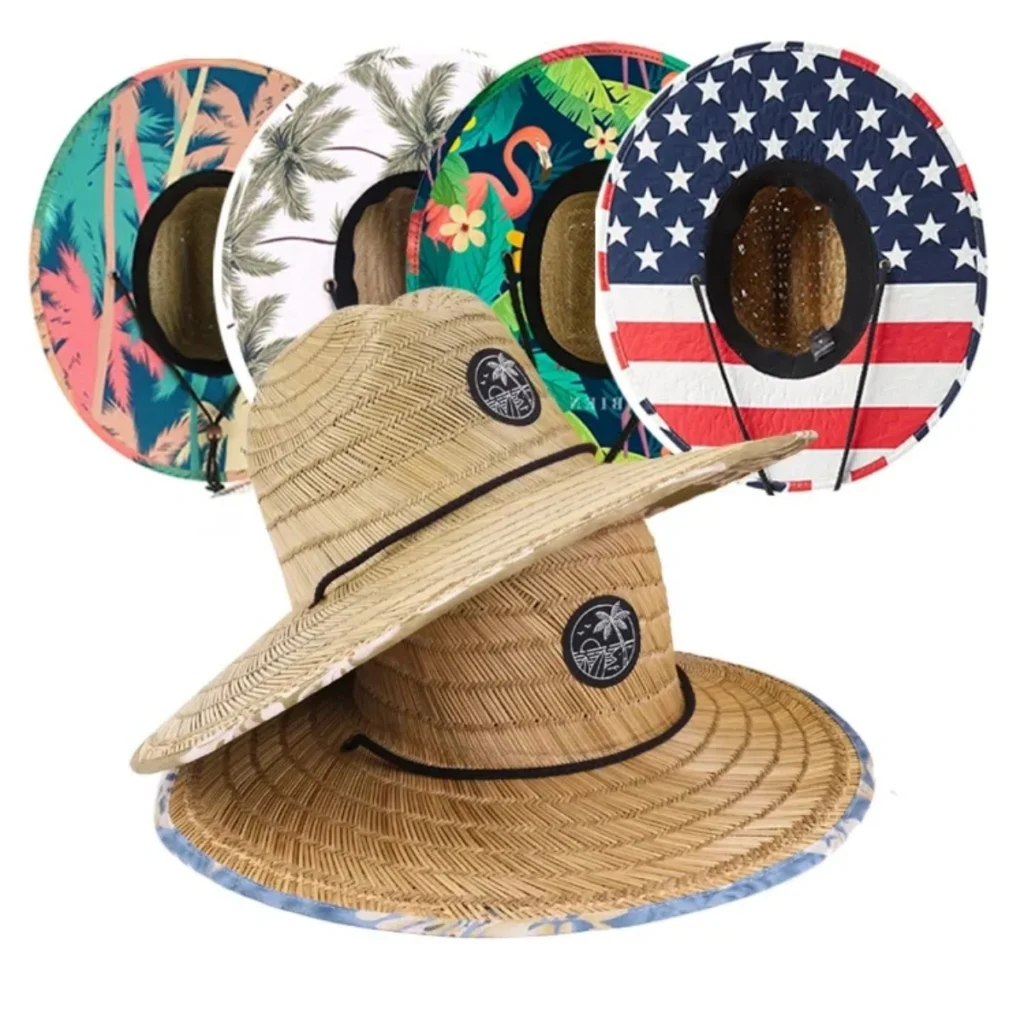
Color Must Be Approved on the Selected Material
A monitor displays a simulation of the intended output. Adobe notes that even a color-managed soft proof depends on the monitor, the relevant device profiles and ambient lighting. A screen preview is therefore useful, but it is not a physical color standard. (Adobe)
Pantone likewise recommends using a current physical standard when a project moves from a digital environment to a physical product because screen and printed color systems behave differently. A Pantone reference improves communication; it does not guarantee an exact result on every material and process. (Pantone)
For a meaningful under-brim color review, provide:
- Brand or Pantone references where available
- The current artwork file and its color information
- Priority colors that need the closest review
- A physical reference when color is commercially critical
- The proposed under-brim material
- An agreed viewing or lighting condition
- A method for recording acceptable variation
Approve color on the physical printed material and finished sample, not from a phone photograph alone. Review the print beside the straw, binding, crown and cord colors, then record any accepted variation. Natural substrate variation and ambient light can influence the perceived relationship among these components, so the approved physical reference should record the accepted color direction.
Review Material, Attachment and Binding as One System
Key takeaway: A print cannot receive final approval separately from the component material and the construction that holds it beneath the brim.
Material and Backing Affect the Finished Brim
In the TerraHats planning materials, a printed under-brim is treated as a printed fabric or liner that must be evaluated with the selected brim construction. The project should not assume unrestricted direct printing on every straw surface.
The selected component may affect:
- Print clarity and background color
- Opacity and surface texture
- Hand feel and flexibility
- Perceived thickness
- How the component lies against the brim
- How its edge behaves during finishing
If a backing, support or additional layer is proposed, include it in the approval sample. A print test on fabric alone cannot show how the complete material stack affects the finished brim.
Record the approved material or bill-of-materials reference rather than only writing “printed fabric.” If the material changes after approval, assess whether print appearance, flexibility, attachment or edge treatment requires another sample.
Attachment and Seams Are Part of the Visible Result
The printed component still needs to become part of the hat. The construction route may create visible stitch lines, joins, tension or transitions around the crown opening and outer edge.
Review whether:
- The printed layer lies as intended
- Wrinkles or tension lines change the design
- The material follows the brim shape
- Attachment lines or seams interrupt important motifs
- The crown opening has a controlled finish
- The under-brim meets the outer edge cleanly
- The final material stack changes the perceived brim thickness or flexibility
Do not approve the printed panel in isolation when the complete sample uses a different attachment or material stack. The sample record should identify the construction that was actually reviewed.
Edge Binding Changes the Artwork Boundary
Brim-edge binding acts as a visual frame around the printed area. Its width, color, material, join and attachment can change how much artwork remains visible.
A border built into the graphic may appear uneven if part of it is covered during binding. Small motifs near the edge may be cut in half. A dark or contrasting binding may separate the print from the straw body—or compete with it.
Approve these elements together:
- Binding material and color direction
- Solid or printed treatment
- Visible width and overall appearance
- Join location and finish
- Relationship to the under-brim artwork
- Amount of print concealed at the edge
- Transition between the binding and the straw surface
Do not sign off on the print while leaving the binding undecided. A binding revision can change the crop, color balance and finished appearance enough to trigger another review.

Under-Brim Approval Checklist: From Mockup to Physical Sample
| Review item | Check at mockup stage | Check on physical sample | Record before release |
|---|---|---|---|
| Artwork identity | Correct design and revision | Sample uses the approved file | File name, revision and issue date |
| Repeat | Tile joins and visual rhythm | Repeat remains balanced across the brim | Repeat type and direction |
| Scale | Approximate motif size and density | Motif size works at the intended viewing distance | Approved dimensions or scale reference |
| Crop | Intended boundary and keep-clear areas | Critical elements remain visible after assembly | Approved crop and protected zones |
| Orientation | Front, back and viewing direction | Direction reads correctly on the hat | Front reference and orientation notes |
| Alignment | Relationship to center and other branding | Visual balance from below and when worn | Alignment reference and acceptable boundary |
| Color | Digital direction and reference codes | Physical appearance on selected material | Physical standard and accepted variation |
| Material | Proposed base component | Texture, opacity, print clarity and flexibility | Material or BOM reference |
| Backing or support | Proposed layer, if applicable | Complete material stack and hand feel | Approved construction reference |
| Attachment and seams | Proposed assembly route | Flatness, visible joins, stitch lines and transitions | Method and visible acceptance points |
| Crown opening | Intended inner boundary | Crop and finishing around the opening | Approved inner-edge appearance |
| Edge binding | Proposed material and color | Visible crop, join and outer-edge finish | Binding specification and sample view |
| Complete appearance | Overall visual direction | Full underside, side and worn views | Physical sample version |
| Approval scope | Items shown in the mockup | Items physically present in the sample | Approved, rejected or not applicable |
| Release control | Current review version | Sample matches the written record | Approver, date and revision status |
Mark non-applicable items explicitly. A blank field can be mistaken for approval. If the sample does not include the final binding, attachment or material, describe it as a partial review rather than final under-brim approval.
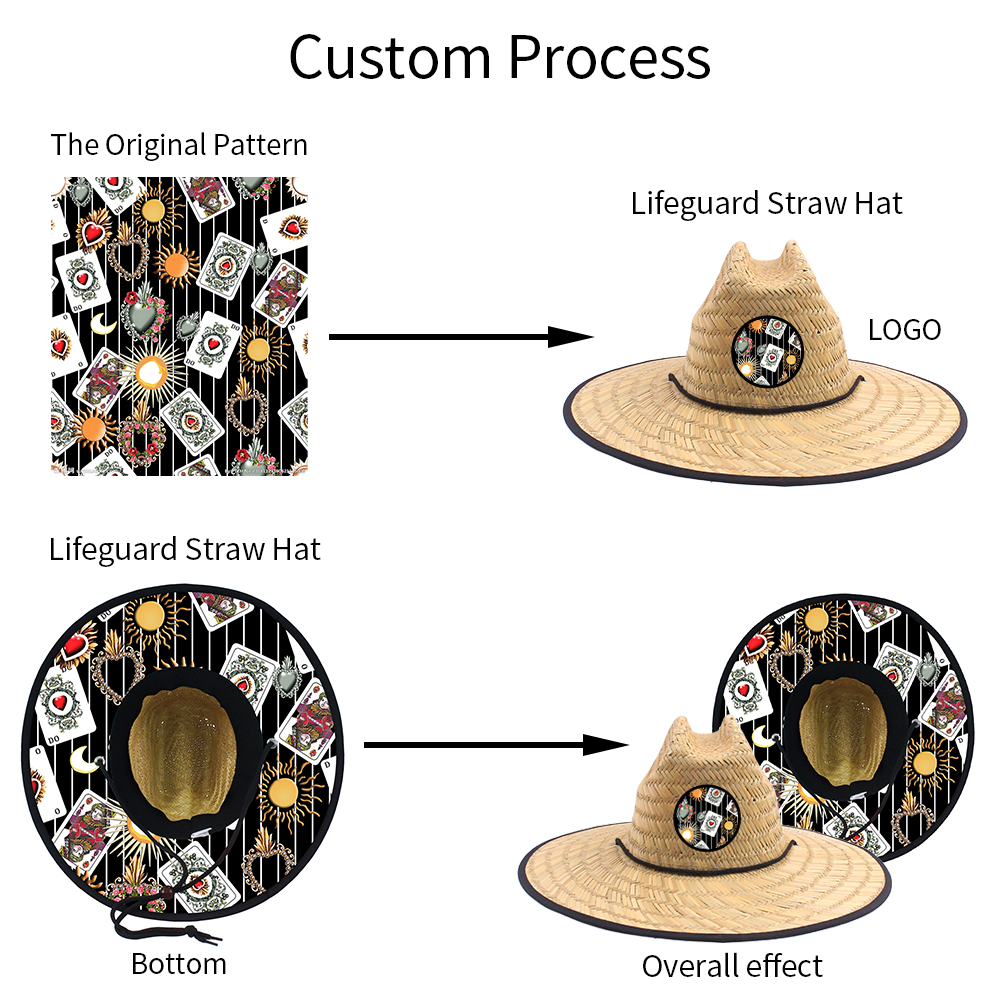
Lock the Approved Reference Before Bulk Release
Link the approved physical sample to the final artwork and written specification. Record the artwork and sample versions, material, crop, orientation, attachment, binding, accepted variation, approver, date and any open deviation. If a later change affects the artwork, brim shape, printed material, attachment or edge treatment, decide whether renewed physical review is needed and document that decision.
This is a control framework, not a promise of fixed sampling steps or timing. For the broader sample, specification and change-control process, read Why Physical Sample Approval Matters Before Bulk.
For related decisions, read Why Logo Placement Changes Visibility and Feasibility and Why Logo Method Changes the Result on Straw Hats.
What Sample Approval Does Not Prove
An approved sample and written specification establish the production reference. They do not automatically prove:
- That every bulk unit will be visually identical
- That later material, artwork or process substitutions are acceptable
- Colorfastness, abrasion resistance or other durability performance
- The approval of packaging or labels not included in the sample
- Bulk-lot conformity without the agreed inspection process
- Delivery timing or commercial terms
- A UPF rating or another compliance claim
Those items need their own specifications, tests, inspections or change-control decisions.
This distinction is especially important for sun-protection language. A printed underside is a design and construction feature; it is not evidence of a UPF rating. ARPANSA explains that UPF testing evaluates material, while product design and body coverage require separate consideration under the applicable standard. If a sun-protection claim is required, confirm the exact tested scope and destination-market labeling rules. (ARPANSA material testing; ARPANSA labeling guidance)
Frequently Asked Questions
Do I need a complete hat sample or only a printed material test?
A material test can help review print clarity and color direction. If the approval scope includes final crop, alignment, attachment and binding, review those details on a complete hat sample.
Can the same under-brim artwork be used on different hat styles?
It should not be assumed. Different brim shapes, dimensions, crown openings and edge constructions can change the scale, crop and visible boundary. Review each selected configuration.
Does a repeat pattern have to be seamless?
Not every design requires a seamless repeat. If the artwork repeats, however, define the tile joins, direction and distribution. The physical sample should confirm that the finished crop does not create distracting clusters or gaps.
Can TerraHats guarantee an exact screen-to-print color match?
A screen image should not be the only color standard. Provide a current physical or recognized color reference where possible, approve the result on the proposed material and record the acceptable variation for the project.
Does a printed under-brim automatically provide UPF protection?
No. Printed decoration, a dark color or the presence of a liner does not automatically establish a UPF rating. Any claim must be supported by evidence for the exact under-brim lining or material in the approved configuration, together with any product-design evidence and labeling required by the destination market.
What should be sent with an under-brim sample request?
Send the selected hat style or reference, current artwork, repeat direction, intended scale and coverage, color references, protected design elements, preferred binding direction, quantity range, destination and target date. MOQ, sampling arrangements and schedule are confirmed after the configuration is reviewed.
Request an Under-Brim Sample
A custom printed under-brim should be approved as a finished product system—not as an isolated graphic.
Share your selected lifeguard hat style, artwork, repeat direction, color references and intended coverage with TerraHats. The team can review the visual direction, identify the details that need confirmation and define an appropriate sample scope.
Explore custom lifeguard straw hat options, compare broader customization options and review the sample policy before production approval.
MOQ, sampling arrangements and production schedule are confirmed according to the selected style, materials, artwork, packaging and order requirements.
Sources and Further Reading
- Adobe — Proofing Colors
- Pantone — Why Physical Color Samples Matter
- ARPANSA — Clothing and Fabric Testing
- ARPANSA — Australian Sun-Protective Clothing Guidance
Editorial claim note: A printed under-brim, dark underside or liner must not be presented as UPF-rated unless the exact material or finished configuration has applicable evidence.