-
WhatsApp +86 15116118247
-
Any Questions info@terrahats.com
Boater vs Fedora vs Panama for Retail Collections
Compare boater, fedora and Panama-style straw hats by silhouette, assortment role, branding surface and packing needs for retail collections.

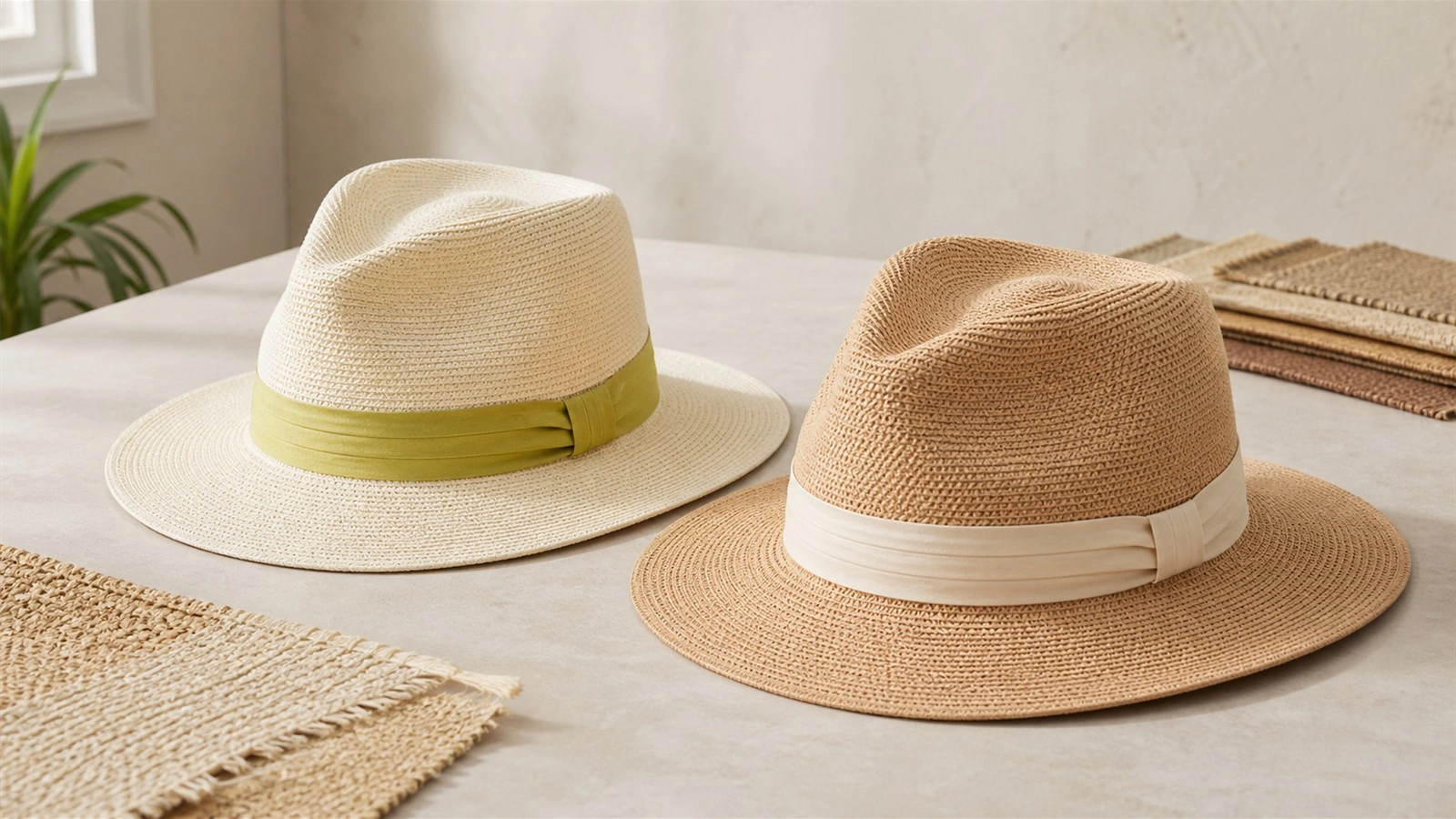
Boater, fedora and Panama hats can all appear in a summer straw collection, but they should not do the same merchandising job.
A boater adds a crisp, graphic silhouette. A fedora provides a shaped, adaptable core style. A Panama-style hat can support a refined warm-weather story, but its product name requires care: “Panama” may refer to the traditional Ecuadorian toquilla craft or may be used commercially as a style description.
For retail and wholesale buyers, the question is not which hat is universally best. It is which silhouette gives the assortment a distinct role—and whether its material, branding, packing and presentation support that role in the finished product.
Table of Contents
Start With the Right Product Language
Boater and fedora are primarily silhouette terms.
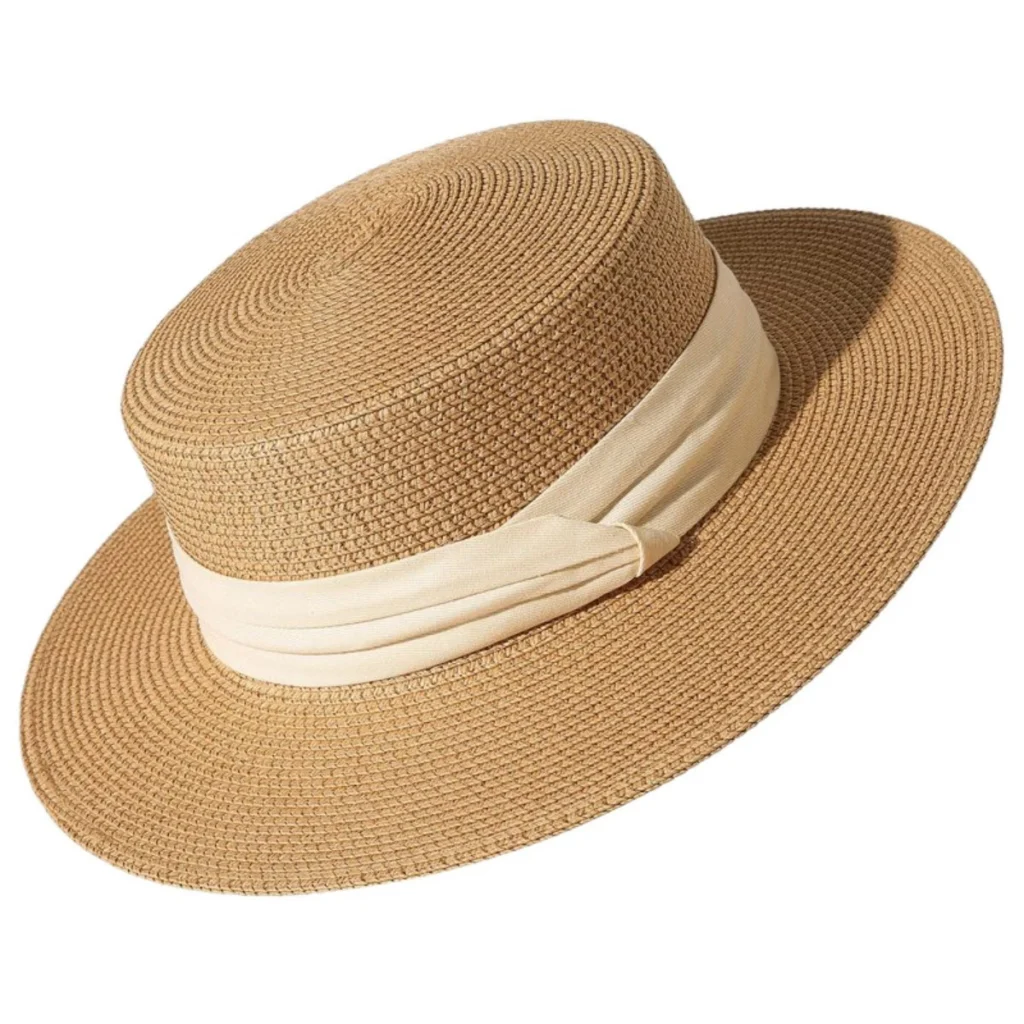
A classic boater is typically identified by a low, flat crown and a comparatively flat, stiff brim. A fedora is recognized by a shaped crown, usually with a lengthwise crease and front pinches, paired with a brim whose width and set can vary.
“Panama” is different. UNESCO’s description of the traditional Ecuadorian toquilla straw hat connects it to fibers from the Carludovica palmata plant and to a specific Ecuadorian preparation, weaving and finishing tradition. It denotes material, origin and craft more than one fixed crown-and-brim shape.
That means a hat can be both a Panama and a fedora: “Panama” can identify the toquilla construction and tradition, while “fedora” identifies the silhouette. It does not mean that every Panama is a fedora, or that every pale straw fedora is a genuine Panama.
In commercial catalogs, “Panama-style” is also used for hats that evoke a warm-weather look without documented Ecuadorian toquilla material or traditional hand weaving. Buyers should therefore separate three ideas:
- Fedora: a silhouette, not a single material.
- Traditional Panama hat: an Ecuadorian toquilla material and craft tradition.
- Panama-style: a commercial visual direction unless material and origin are verified.
This article compares assortment roles. Any claim about authentic Panama hats, toquilla fiber or Ecuadorian provenance still requires product-specific evidence.
Boater vs Fedora vs Panama-Style: Buyer Decision Table
Use this table to plan an assortment, then confirm every detail on the selected sample.
| Direction | Recognizable silhouette | Best assortment role | Branding surfaces to review | Packing and display questions | Evidence required before approval |
|---|---|---|---|---|---|
| Boater | Typically a low, flat crown and comparatively flat brim with a strong horizontal line | Graphic seasonal statement, event or uniform direction, resort story | Crown band, side label, sweatband, hangtag and packaging | Does the brim remain level? Is the crown protected from compression? | Crown and brim dimensions, edge finish, band placement, material declaration and packed sample |
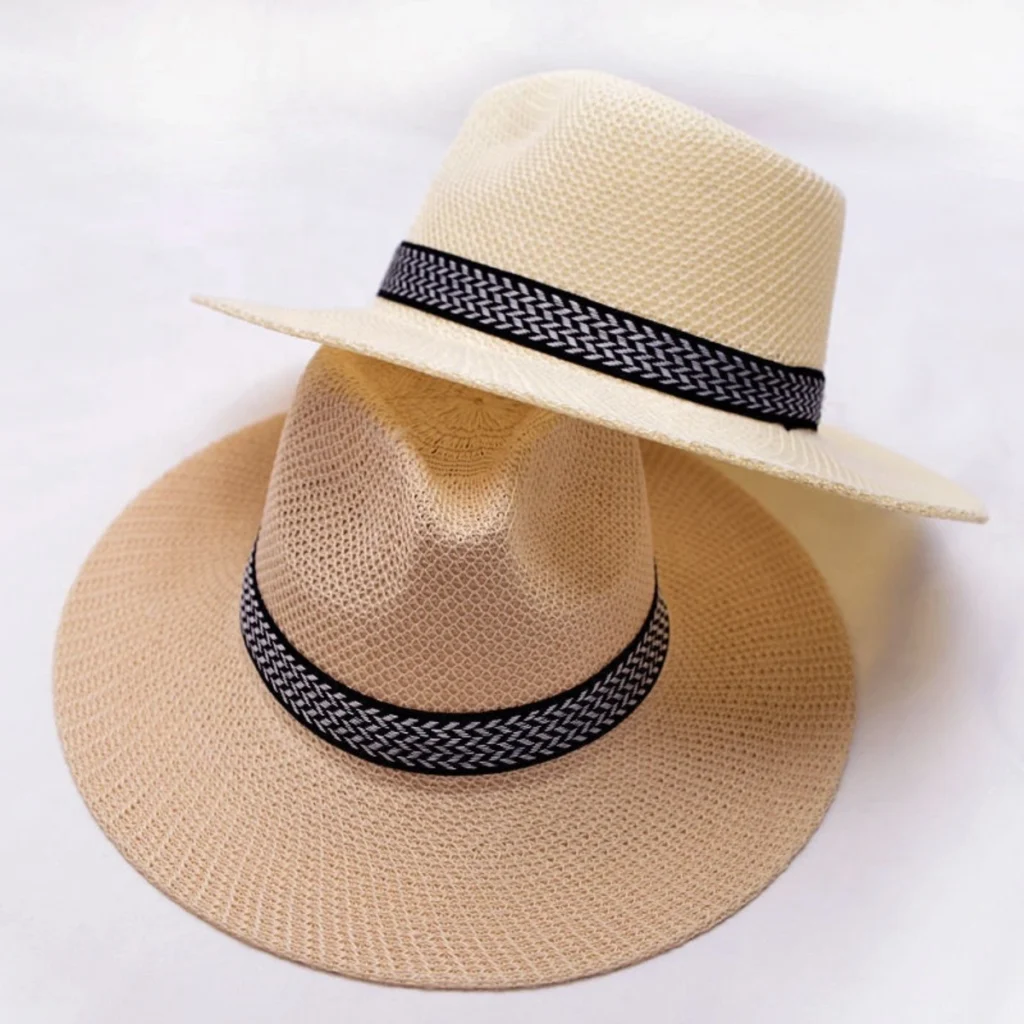
| Fedora | Creased crown, often with front pinches; brim width and angle vary | Flexible fashion core, casual-to-dress bridge, brand-led collection | Hatband, side trim, compatible crown decoration, sweatband and labels | Are the crease and pinches protected? Does the brim retain the approved set? | Crown block, pinch symmetry, brim set, trim position, construction and packing method |
| Panama-style | Must be defined by the agreed reference; often fedora-adjacent, but not one fixed shape | Refined summer, travel, resort or gifting story | Band, bow, subtle side branding, sweatband, labels and retail packaging | Does the selected construction tolerate the proposed packing method? | Whether “Panama” is only a style term or a documented material/origin claim, plus the complete approved sample |
The strongest range gives each SKU a visible reason to exist. If a fedora and Panama-style SKU share nearly identical crown blocks, brim widths, bands and colors, they may compete with each other rather than broaden the assortment.
Crown and Brim Profiles Create the First Difference
Customers usually read the outline before they notice fiber, weave or trim. Crown and brim architecture should therefore be the first buying decision.
Boater: A Controlled, Geometric Profile
The boater’s horizontal geometry can look heritage-led, festive or contemporary depending on proportion and trim. That simplicity also makes variation easy to see: a lifted brim, leaning crown or uneven band can interrupt the intended line.
Review the sample from front, side and overhead, checking:
- Crown height, top shape and side-wall angle
- Brim width, flatness and left-to-right balance
- Crown-to-brim symmetry
- Edge construction
- Band width, position, overlap and bow placement
A compact brim and a broader brim can create different collection roles. Neither should be assumed from the category name; dimensions and reference views belong in the specification.
Compare available straw boater hat directions.
Fedora: A Shape Defined by Creases and Curves
The fedora carries more sculpted information in the crown. The center crease, front pinches, taper and brim set work together to create the final expression. It is also not limited to one material: felt is common, but straw and other seasonal constructions can be formed into fedora silhouettes.
Small changes can move the same family from relaxed to formal:
- Deep or shallow crown crease
- Sharp or soft front pinches
- Straight or tapered crown wall
- Narrow, medium or wide brim
- Downturned, snapped or otherwise specified brim set
- Tonal, contrasting or textured band
“Straw fedora” is therefore not a complete development brief. Buyers should identify the crown block and brim direction, then confirm that the chosen construction reproduces the shape and finish on a physical sample.
Browse straw fedora hat directions.
Panama-Style: Define the Product Before Using the Label
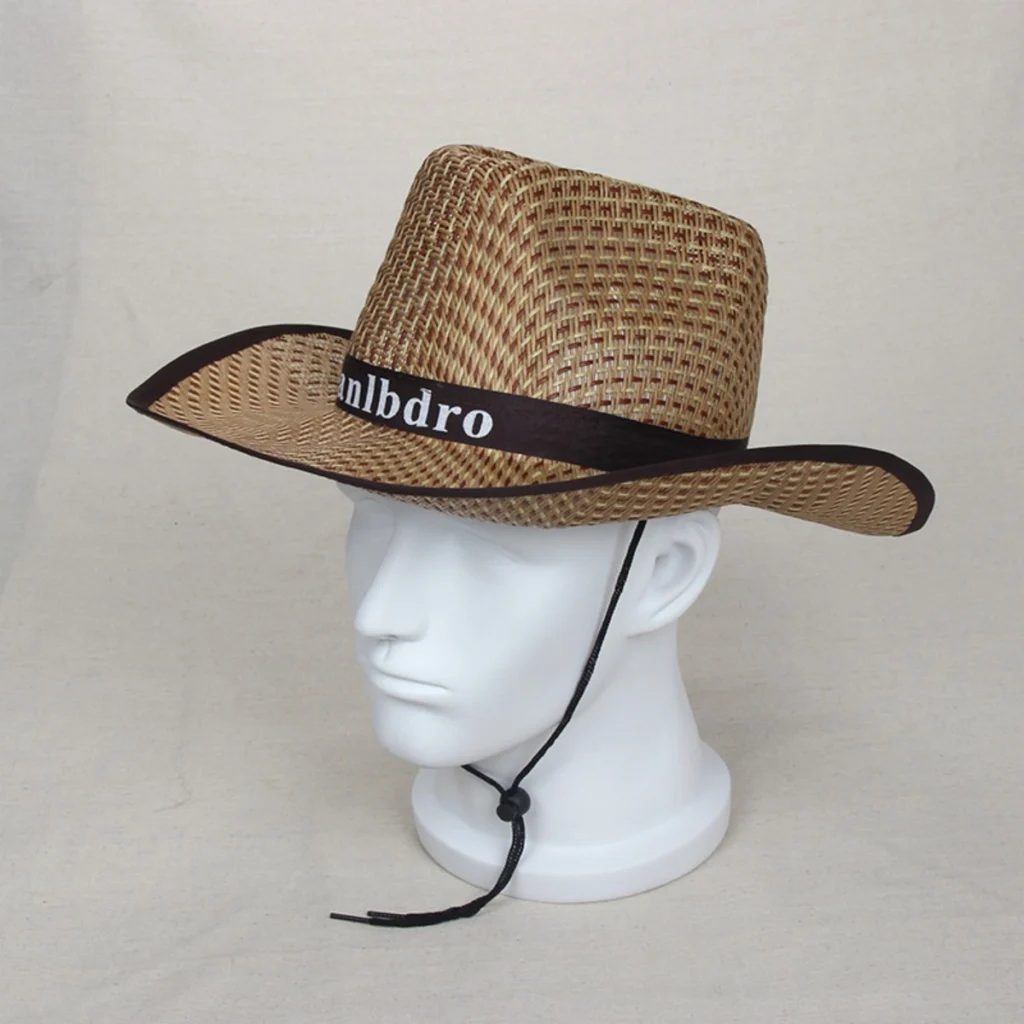
Many commercial Panama-style hats use a center-dent or pinched crown associated with fedoras. That overlap is why “Panama” cannot serve as a complete shape instruction.
Record the intended crown, crease, front pinch, brim width and set, surface direction, edge treatment, band, color and material declaration. If origin or craft is part of the sales story, record the evidence required for that claim as well.
If Ecuadorian toquilla material and traditional hand weaving are not supported, “Panama-style” is the safer term. The Panama-style straw hat category can support visual comparison, but the category label alone does not establish fiber, origin or manufacturing method.
Match the Material System to the Intended Shape
Choosing the silhouette is only the first half of the development brief. The material, braid or weave, stiffening, blocking method, edge construction and finishing process must work together to hold that silhouette.
A fiber name alone does not predict rigidity, flexibility or shape recovery. Paper-based braid, Toyo, raffia, wheat straw and toquilla can each appear in different constructions and finishes. Buyers should therefore avoid statements such as “raffia is always soft” or “paper straw is always packable.” Approve the complete material-and-construction system instead.
| Material direction | What the name does—and does not—tell the buyer | Shape-control question | Sample evidence to request |
|---|---|---|---|
| Paper-based or Toyo braid | Identifies a processed material direction, but not its finished stiffness, coating, braid width or recovery | Can this exact braid and finish hold the required flat plane, crown crease or brim set? | Material declaration, braid reference, formed sample, edge detail and packing trial |
| Raffia or raffia-style direction | May suggest a natural or irregular surface; the name alone does not establish softness, fiber identity or dimensional stability | Does the approved weave support the intended geometry without unacceptable waviness, stretch or asymmetry? | Verified composition, weave reference, tolerance sample and complete-hat review |
| Wheat or another named plant-straw direction | A plant name still does not define strand preparation, braid construction, stiffening or blocking | Can the selected construction reproduce the crown and brim consistently at production scale? | Material documentation, construction specification, dimensional sample and edge review |
| Open or mixed weave | Describes visible spacing or multiple weave zones more clearly than it predicts strength or airflow | Do open areas, joins and transitions provide enough support for the silhouette and branding method? | Weave map, reinforcement details, decorated sample and shape-tolerance reference |
| Documented Ecuadorian toquilla | Can support a verified material, origin and craft story; it does not guarantee one silhouette or universal rollability | How do weave, blocking and finishing affect the approved crown, brim and handling method? | Provenance documents where required, material declaration, finished sample and product-specific packing test |
For a geometric boater, translate “keep the brim flat” into a measurable brim plane, edge profile and packed-sample acceptance standard. For a fedora, define crease depth, pinch symmetry and brim set. For a Panama-style direction, approve both the physical shape and the terminology supported by the product evidence.
Three Silhouettes, Three Collection Roles
Boater: The Graphic Accent
A boater can make a seasonal range recognizable through its strong horizontal profile. It may work as a window-display focal piece, limited color story, hospitality accessory, event direction or fashion-led SKU with a distinctive band.
Because the silhouette is specific, it does not need to carry every color or decoration option. Its job may be to create the collection’s clearest visual punctuation.
Fedora: The Adaptable Core
A fedora often offers the broadest design flexibility because the crown definition, brim proportion, color and trim can be adjusted for different market positions. It can support an entry style, casual summer accessory, dress-led SKU, branded resort product or coordinated private-label range.
That flexibility also creates duplication risk. If several fedoras are planned, differentiate them through sample-visible attributes rather than internal product names alone.
Panama-Style: The Refined Story
A Panama-style direction can anchor a refined summer, travel or resort story. The marketing language must match the evidence.
When Ecuadorian toquilla construction and provenance are documented, those facts may be considered for product positioning after verification. When they are not, sell the product through confirmed attributes such as silhouette, composition, color, trim and finish.
This article intentionally stops there. A later sourcing guide can examine Panama-versus-fedora material, construction and origin in greater detail without turning this assortment article into a competing taxonomy page.
Build a Buyer-Defined Price Ladder
Silhouette alone does not determine retail price. The same boater or fedora family can support more than one tier when material, construction, finishing, trim, provenance, packaging and order economics differ meaningfully.
| Direction | Useful occasion or merchandising role | Price-architecture guidance |
|---|---|---|
| Boater | Summer events, hospitality, coordinated staff programs, occasion-led retail and graphic displays | Can serve as an accent at different tiers. Set the target only after material, band treatment, shape-control requirements and protective packing are costed. |
| Fedora | Everyday summer, resort, fashion accessories and a repeatable core range | Can span entry through premium positions. Differentiate tiers through verified construction, finish, trim and packaging—not the word “fedora” alone. |
| Panama-style or documented Panama | Refined resort, travel-themed merchandising, gifting and provenance-led collections | A documented Ecuadorian toquilla story may support a premium position, but “Panama-style” alone does not. Price the actual material, labor, evidence, finish and presentation. |
A Good-Better-Best ladder can be built within any one silhouette. Buyers should compare landed cost, intended retail price, target margin and the visible reason for each upgrade before adding another SKU.
Compare Branding Surfaces on the Actual Hat
Logo feasibility depends on the complete construction, including weave openness, surface variation, reinforcement and access for the attachment method.
The crown band is the most natural shared branding zone, but it behaves differently on each shape. On a boater, it reinforces the horizontal geometry and can become the dominant color or identity surface. On a fedora, it must sit correctly against crown taper and pinches. On a refined Panama-style product, a restrained band, bow or label may better support the intended position—but that remains a collection choice, not a universal rule.
Before approving patches, embroidery or applied marks, check:
- Whether the attachment area is stable
- Whether stitches or fasteners cross open spaces
- Whether the decoration pulls or compresses the weave
- Whether the mark sits level on the shaped crown
- Whether backing or reinforcement is required
- Whether the attachment changes the visible interior
If direct crown decoration is unsuitable, consider a band label, interior label, hangtag or branded packaging. Approve the decorated physical sample, not only the digital mockup.
For coordinated labels, trims and packaging, plan a private-label straw hat collection.
Packing and Display Are Part of Product Approval
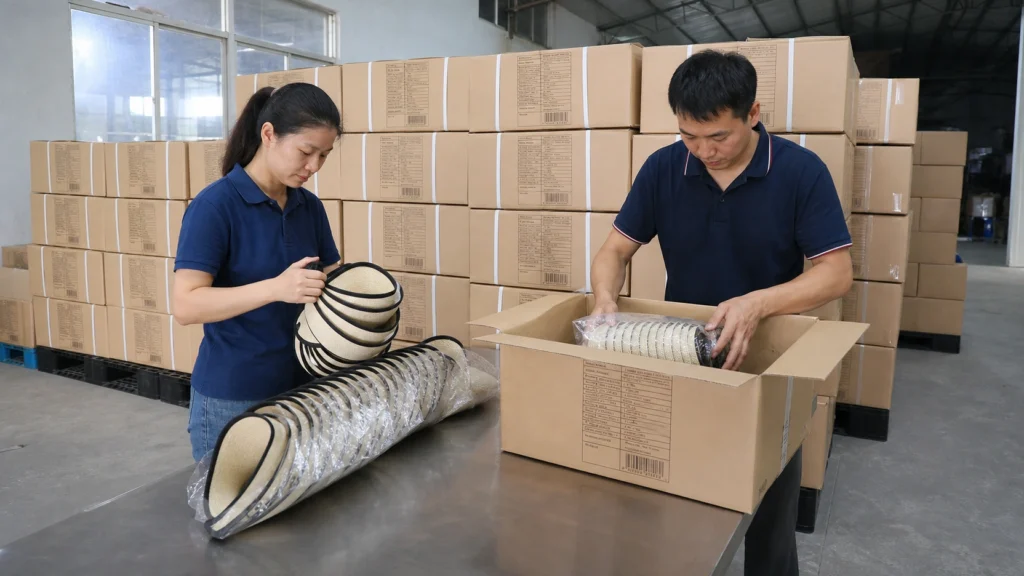
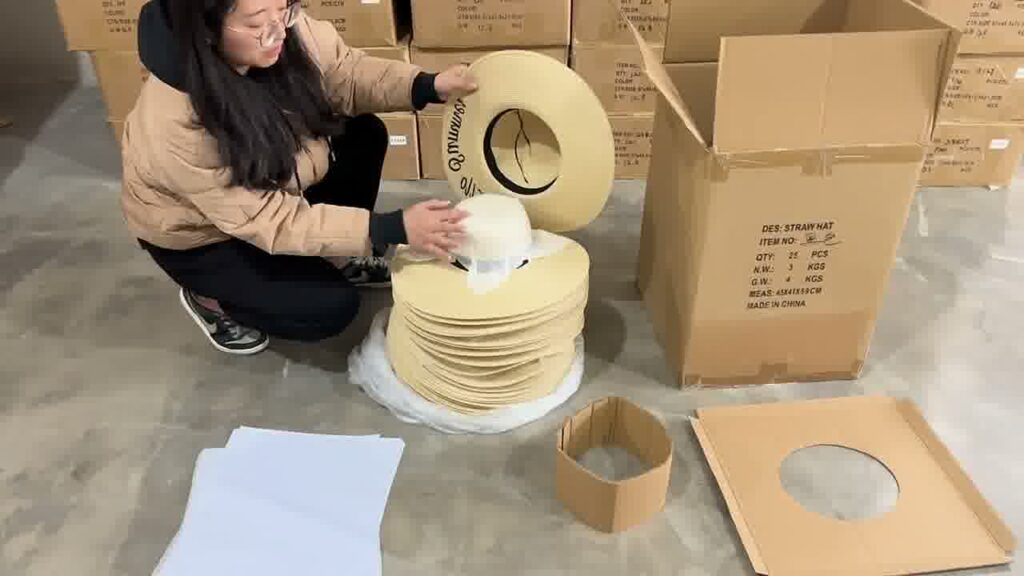
Packing affects the product customers receive and the shape retailers place on display. Do not infer packability from the words “straw,” “fedora” or “Panama.” Some specific products are designed to roll or fold; others require structured support. The feature must be verified for the exact SKU, material, finish and recovery method.
For a boater, check whether the brim stays level, the crown remains flat and the band stays in position after the proposed pack-out. For a fedora, inspect pressure at the crease and front pinches, brim interaction between nested units and the shape after unpacking. For a Panama-style hat, define packing only after the actual construction is known.
If compact packing is part of the concept, document:
- The exact rolling or folding method
- Packing duration and conditions
- The unpacking and reshaping method, if any
- The evaluation interval
- Acceptable recovery criteria
Retail presentation may also require tissue, crown support, a sleeve, individual box, hangtag, size label or another component. These decisions affect protection, carton efficiency and the customer’s first impression.
Record the Inputs That Affect Freight and Storage Cost
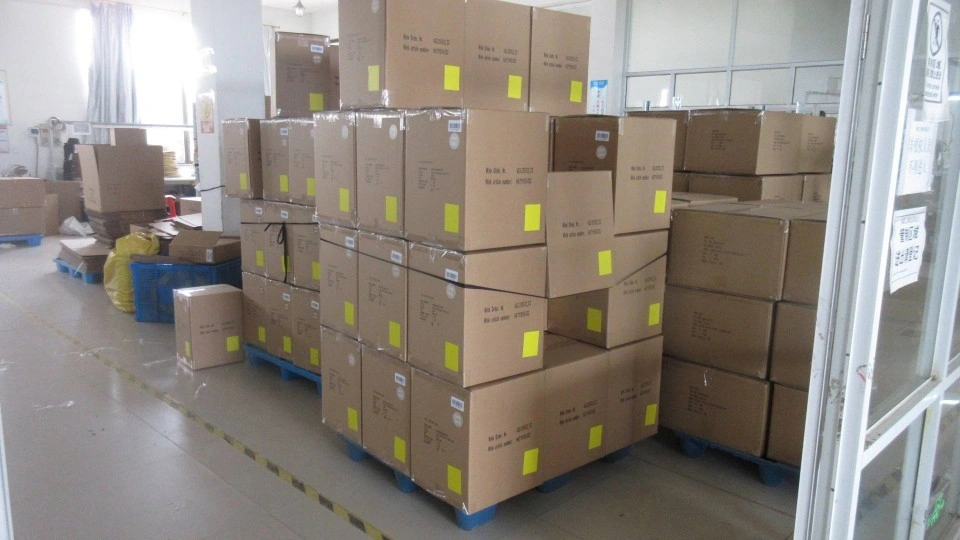
Protective packing can change both product condition and landed cost. Request comparable pack-out data for every shortlisted SKU instead of assuming that a “packable” product will automatically be cheaper to ship.
| Packing input | What the buyer should record | Why it matters |
|---|---|---|
| Unit packed dimensions | Length, width and height using the approved unit pack | Supports shelf, storage and fulfillment planning |
| Master-carton dimensions | External carton dimensions for the quoted pack-out | Used to calculate shipment volume and carrier chargeable weight |
| Units per carton | Quantity, size/color mix and nesting arrangement | Allows cost and damage risk to be compared per sellable unit |
| Net and gross weight | Product weight and total packed-carton weight | Supports freight quotations, handling limits and warehouse planning |
| Shape-protection components | Crown supports, brim separators, tissue, sleeves, inner boxes and dividers | Identifies both added protection and added volume/material cost |
| Post-unpacking result | Immediate condition, allowed recovery time and acceptance criteria | Prevents a low-volume pack-out from being approved without checking retail-ready appearance |
Air and courier services may calculate chargeable weight from carton volume rather than actual weight. Ask the logistics provider which dimensional-weight divisor and rules apply to the quoted route; do not hard-code one universal formula into the product specification.
Avoid Three Common Assortment Mistakes
1. Buying Names Instead of Silhouettes
A line plan listing “boater, fedora and Panama” may look varied while the samples remain visually close. Compare front, side and overhead views at the same scale before approving the range.
2. Treating Panama as Proof of Material or Origin
A Panama label does not by itself confirm toquilla fiber, Ecuadorian origin or traditional hand weaving. Request documentation for every material, geographic or craft claim that will appear in marketing or labeling.
3. Approving the Blank Hat Before Branding and Packing
A blank sample may pass while decoration or packing introduces new issues. Include final trim, labels and the intended packing condition in the approval sequence, or record them clearly as open items.
Sample Approval Checklist
Keep comments, measurements and decisions in one consolidated record.
Style and assortment role
- Identify the SKU as boater, fedora, Panama-style or a verified Ecuadorian toquilla Panama construction
- Match material and origin language to available evidence
- Attach front, side and overhead references
- Define the SKU’s distinct role in the range
Crown, brim and material
- Record crown height, taper, crease, pinches and symmetry
- Measure brim width at agreed points and approve its set
- Confirm edge construction and acceptable shape variation
- Record commercial material name and composition in the specification or BOM
- Record braid or weave, stiffening, blocking, reinforcement and finishing where applicable
- Approve weave, color and permitted variation
Branding and private label
- Identify the final artwork version
- Confirm band, bow, label, patch or trim dimensions and placement
- Review the decoration’s interaction with the weave
- Include sweatband, care label, size label, hangtag and packaging where applicable
- Retain the decorated sample as an approval reference
Packing and display
- List all unit-packing components
- Confirm crown and brim supports
- Test nesting or compact packing when proposed
- Review the sample after the agreed packing trial
- Record carton orientation, assortment labels and display condition
Approval record
- Attach the measurement sheet
- Retain the physical control sample
- List approved deviations and open changes
- Record the approver and approval date
- Define which changes require another sample review
The TerraHats sample policy can help buyers plan review of the hat body, decoration and packing specification before bulk production.
Frequently Asked Questions
Can a Panama hat also be a fedora?
Yes. “Fedora” can describe the crown-and-brim silhouette, while a traditional Panama designation can describe the Ecuadorian toquilla material and craft tradition. One product can meet both descriptions, but not every Panama is a fedora and not every straw fedora is a genuine Panama.
What is the main difference between a boater and a fedora?
A classic boater typically has a flatter crown and brim with a strong horizontal profile. A fedora uses a shaped crown, usually with a lengthwise crease and front pinches, and its brim set can vary. Final dimensions and stiffness still need to be defined on the selected product.
Does the material name tell us which silhouette it can support?
No. Fiber identity is only one part of the construction. Braid or weave, stiffening, blocking, reinforcement, edge treatment and finishing all affect the finished shape. Approve the complete construction against measurable crown and brim requirements.
Which of these hats can be rolled or folded?
None of the three categories is universally rollable or foldable. Packability must be confirmed for the exact SKU through a defined packing, unpacking and recovery test. Do not infer it from “boater,” “fedora,” “Panama,” fiber name or weave grade alone.
What packing data should a retail buyer request?
Request unit and master-carton dimensions, units per carton, net and gross weight, support components, nesting arrangement and the product’s condition after the agreed packing trial. Use those values to compare freight, storage, fulfillment and damage risk per sellable unit.
Choose the Collection Role Before Choosing the Name
Boater, fedora and Panama-style hats are not interchangeable search terms for one summer product.
Choose a boater when the assortment needs a flat, graphic silhouette. Choose a fedora when it needs a shaped, adaptable core style. Choose a Panama-style direction when a refined warm-weather story fits the customer—but verify the material and origin before turning that story into a product claim.
Then specify the result: crown, brim, material, weave, color, trim, branding and packed presentation. A defined, decorated and packing-tested sample is more useful than the category name alone.
Compare production-ready styles for your next retail collection.
Browse TerraHats product categories and share your target customer, intended price position, silhouette references, material direction, branding requirements and packing expectations for a sample review.
Sources and Further Reading
- UNESCO — Traditional weaving of the Ecuadorian toquilla straw hat
- Smithsonian National Museum of African American History and Culture — Straw boater hat
- Museums Victoria Collections — Men’s straw boater hat
- Lock & Co. Hatters — What is a fedora hat?
- Stetson — Center Dent Panama Fedora
- Stetson — Airway Panama Safari Hat
- Lock & Co. Hatters — Hat care tips