-
WhatsApp +86 15116118247
-
Any Questions info@terrahats.com
Why Brim and Crown Measurements Belong in the Spec
See why brim width, crown height and circumference need defined measurement methods before custom wide-brim hat production.

“Wide brim,” “high crown” and “one size” may help describe a hat, but they do not define a finished product.
Two hats can share the same style name while differing in brim projection, crown depth, opening shape and overall proportion. A reference photograph may show the intended look, yet still leave basic questions unanswered. Where does the brim measurement begin? Is a curved brim measured in a straight line or along its surface? Is crown height taken at the front, side or highest point?
That ambiguity matters in custom production. Brim width affects the silhouette, packing footprint and usable decoration area. Crown height affects visual proportion, interior depth and logo placement. The internal opening influences how the hat sits on the wearer. If the measurement method changes, two people can inspect the same sample and report different results.
The solution is not a universal chart for every straw hat. It is an order-specific specification that identifies:
- What is measured
- The start and end points
- The measurement path
- The tool and product condition
- The target value and unit
- The product-specific tolerance
- The approved sample and document version
Table of Contents
Quick Answer: Why Put Brim and Crown Measurements in the Spec?
Brim and crown measurements belong in the specification because a style name does not define finished dimensions or fit.
A production-ready spec should state how each important dimension is taken. It should distinguish front brim projection from side or back projection, define the crown-height landmark and clarify whether “circumference” refers to the wearer’s head or the hat’s finished internal opening.
The physical sample shows the approved three-dimensional result. The written specification makes critical dimensions repeatable and inspectable. For most custom programs, they work best as a controlled pair: the sample communicates shape, texture and proportion, while the spec records requirements that cannot be reliably inferred by sight.
Style Names Are Not Measurement Methods
A buyer searching for wide brim hat dimensions may expect one standard set of values. In production, however, “wide brim” is a product-family description rather than a complete dimensional definition. Buyers can compare available wide-brim straw sun hat directions, but the selected style still needs its own measurements.
The finished result may vary with:
- Hat category and intended silhouette
- Adult, youth or child sizing
- Crown profile and depth
- Oval or round opening direction
- Brim curve, slope or edge treatment
- Material, weave and reinforcement
- Binding or under-brim construction
- Blocking, finishing and packing method
Formal procurement specifications illustrate why named dimensions need defined methods. The DLA record for MIL-DTL-44105, Hat, Sun, Hot Weather, for example, shows how dimensional requirements can be documented for a particular product. It is an example of specification discipline—not a commercial sizing chart or a claim that TerraHats products meet a military specification.
ISO 18890:2018 similarly reflects the broader principle that garment measurement points and methods should be defined. It is not a hat-specific certification. The practical lesson is simpler: a number becomes useful to production only when both parties know exactly what it represents.
What Dimensions Can Buyers Use as a Starting Point?
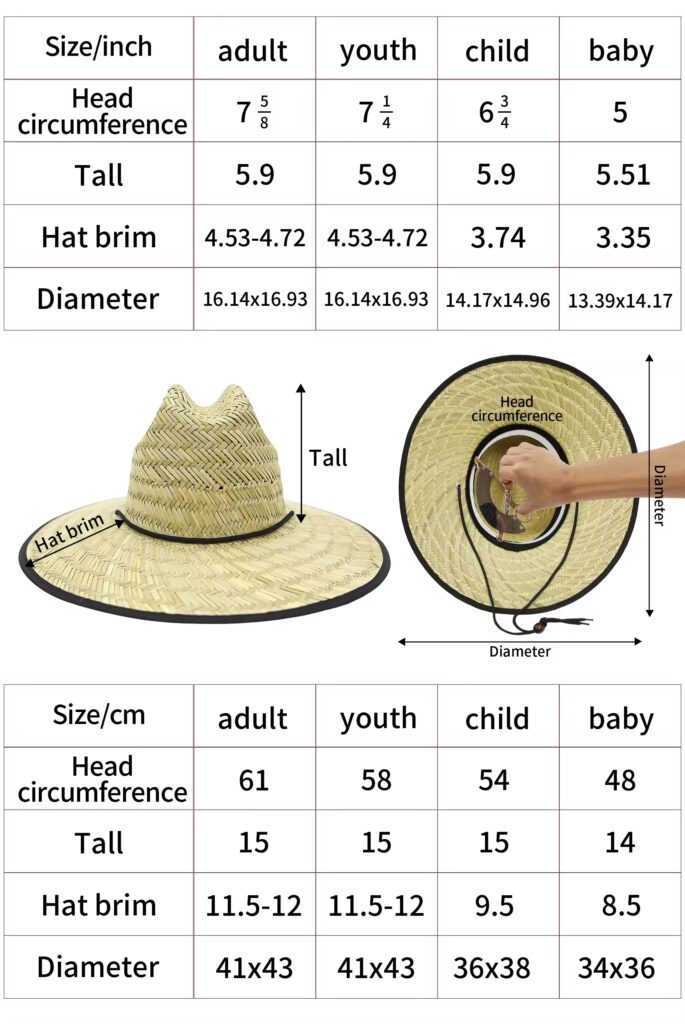
There is no universal commercial range for every wide-brim hat. However, buyers still need numbers to begin a product brief. The table below uses TerraHats’ current product-development reference material as a planning baseline—not as a size promise for every SKU.
| Reference direction | Internal opening or head-size reference | Reported hat-height reference | Brim reference | How to use it |
|---|---|---|---|---|
| Unisex wide-brim reference | 56–58 cm (22.0–22.8 in) | 15 cm (5.9 in) | 11.5 cm (4.5 in) | Use as an inquiry starting point; confirm the opening path and crown-height landmark on the selected sample |
| Adult wide-brim reference | Confirm for selected size | 15 cm (5.9 in) | 11.5–12 cm (4.5–4.7 in) | Use to discuss proportion, then approve the exact size and method by SKU |
| Youth wide-brim reference | Confirm for selected size | 15 cm (5.9 in) | 11.5–12 cm (4.5–4.7 in) | Confirm wearer group, opening, brim proportion and fit on a physical sample |
These figures answer the buyer’s first question—what scale might we start discussing?—without turning a working reference into a universal standard. “Reported hat height” must still be converted into a controlled crown-height field with a named base and endpoint. Size allocation, tolerances and final values should be confirmed for the actual material, construction and wearer group.
Application standards can use different baselines. ARPANSA notes that AS/NZS 4399:2020 clarifies separate minimum brim requirements for bucket, legionnaire and broad-brimmed sun-protective hats. That is another reason not to present one generic number as suitable for every style, market or claim.
Define Each Measurement Field and Method
The following table is a practical starting point for a custom hat tech pack. The final fields and methods should be selected for the actual style.
| Measurement field | What to define | Example specification wording | Risk if left ambiguous |
|---|---|---|---|
| Internal head opening | Path, opening condition, sweatband treatment and whether the value describes the hat or wearer | Measure the finished internal opening along the agreed sweatband path without stretching | Wearer head circumference is not automatically identical to the finished opening |
| Front brim projection | Crown-to-brim start point, direction and straight-line or surface path | Measure from the defined center-front crown–brim junction to the finished outer edge using the stated path | A curved brim gives different results when measured as a projection or along its surface |
| Side brim projection | Side landmark and left/right recording rule | Measure at the defined side positions; record both sides when symmetry is critical | One front value does not describe a shaped or asymmetric brim |
| Back brim projection | Center-back landmark and finished edge point | Measure from the defined center-back junction to the finished outer edge | Back projection may intentionally differ from the front |
| Crown height | Base datum, position, target point and product condition | Measure from the defined crown base to the named front, side, back or highest point without compressing the crown | Pinches, slopes and domes make “crown height” open to interpretation |
| Crown opening length and width | Interior or exterior method, axes and product condition | Measure the approved front-to-back and side-to-side axes with the stated tool or fixture | Openings with the same perimeter can still have different shapes |
| Overall length and width | Axes, brim condition and whether the edge is relaxed or flattened | Measure across the finished hat on the stated axes under the agreed resting condition | Flattening a curved brim can alter the result |
| Brim profile | Reference plane, location and comparison method | Compare the relaxed finished shape with the approved sample, profile image or agreed fixture | Width alone does not control slope, curl or edge lift |
| Decoration position | Datum, artwork edge and direction | Locate the logo from the defined center line, seam, brim edge or crown base | Placement can shift visually when crown and brim proportions change |
A production drawing should mark the same points visually. Letter codes such as A, B and C are helpful only when the drawing and measurement table share the same version.
Head Circumference and Hat Opening Are Different Fields
Buyer instructions often use “circumference” without saying what is being measured.
Wearer head circumference is an anthropometric input. It describes the intended wearer and is normally taken with a flexible tape around an agreed path on the head.
Finished internal opening is a product measurement. It describes the hat after construction and may be affected by the sweatband, material thickness, opening shape, adjuster and intended fit allowance.
The two values are related, but one should not be substituted for the other without a product-specific fit decision. A spec may need to identify:
- Intended wearer group and size designation
- Head-measurement guidance used by the buyer
- Finished internal-opening method
- Opening length and width where shape matters
- Adjustment state, if applicable
- Approved fit reference or wear trial
- Method for evaluating bulk units
“One size” still needs a defined product measurement and an agreed intended-fit range. It is not a measurement method.
Crown Height Needs a Landmark
Crown height sounds straightforward until the crown is pinched, domed, sloped or creased.
A ruler placed at the side may produce a different result from one placed at the front. Measuring to the highest point may not describe the depth available where the hat sits. Pressing a soft crown can change the reading again.
For the selected style, record:
- Where the crown base begins
- Whether the datum is the brim plane, lower crown edge or another landmark
- Whether height is measured at the front, side, back or highest point
- Whether multiple height fields are required
- Whether the hat is empty, supported or placed on a form
- Whether the crown is measured relaxed and uncompressed
- How pinches, folds and creases are treated
- Which sample and profile image show the approved shape
A crown measurement controls a defined part of the structure. It does not replace the approved three-dimensional profile.
Turn a Measured Sample Into a Tech Pack Entry
The following hypothetical example shows how target values and methods can appear in a tech pack. It is for illustration only; it does not state a TerraHats production offer or universal tolerances.
| Spec field | Hypothetical target | Point-to-point method and condition |
|---|---|---|
| Style | WH-01 | Wide-brim straw hat |
| Sample reference | WH-01-V3 | Identified physical sample and controlled profile image |
| Size | Adult | Buyer-approved size designation |
| Internal opening | 57.0 cm | Along the installed sweatband path without stretching; adjuster in the approved neutral position |
| Crown height, side | 15.0 cm | From the named side crown base to the approved upper landmark; crown relaxed and uncompressed |
| Front brim projection | 11.5 cm | Straight-line projection from the center-front crown–brim junction to the finished edge |
| Side brim projection | 11.5 cm left / 11.5 cm right | Straight-line projection at the named side positions; hat resting in the approved orientation |
| Back brim projection | 11.0 cm | Straight-line projection from the center-back junction to the finished edge |
| Brim profile | Match WH-01-V3 | Compare the relaxed curve with the controlled side-profile image |
| Tolerances | Approve by field | Record a separate acceptance limit only after sample and process review |
| Document control | WH-01-R4 | Record sample version, approver, approval date, tool and inspection result |
The numbers are useful because the landmarks and product condition travel with them. Before bulk release, connect the table to the identified sample through the TerraHats sample-approval process. If a revision changes crown height, brim reinforcement or opening construction, update the document and decide whether a new sample or other approval evidence is required.
Tolerances Must Be Product-Specific
A tolerance is not a vague statement that “some difference is normal.” It is an agreed acceptance boundary attached to a defined characteristic and measurement method.
The appropriate limit may differ by:
- Material and weave
- Hat style and size
- Brim reinforcement
- Crown structure
- Binding or edge construction
- Measurement location
- Product function and buyer priorities
- Measurement-tool resolution
- Approved sample evidence
- Production and inspection capability
There is no single tolerance TerraHats can responsibly publish for every hat and every dimension. The target value and its acceptance tolerance should be recorded separately.
Environmental and handling conditions may also matter. ISO 139:2005 defines standard atmospheres for conditioning and testing textiles. That does not make ISO 139 the required method for every straw-hat inspection. It does illustrate why a spec should state the product condition or agreed environment when these factors could materially affect the result.
How Material and Construction Change the Control Plan
Material names do not automatically determine a tolerance, but construction affects how a dimension should be stabilized and checked.
| Product condition | Measurement implication | Practical control |
|---|---|---|
| Coarser or more open natural weave | The brim or crown may not present one perfectly rigid landmark | Define the relaxed position, support method and exact point used for comparison |
| Reinforced or bound brim | Reinforcement and edge finishing become part of the finished measurement | Measure to the completed outer edge and approve the profile after all edge components are installed |
| Printed under-brim or added lining | Assembly can change how the brim rests or curves | Approve dimensions and profile on the completed construction, not only on the undecorated body |
| Different material proposed for a repeat order | A familiar target may not reproduce through the same forming process | Recheck the sample, method and achievable tolerance before treating the substitution as equivalent |
The goal is not to assume that one material is always more dimensionally consistent than another. It is to validate the control plan against the selected body, reinforcement, components and finishing route. Buyers can review relevant customization options before locking these fields.
Common Measurement Mistakes
Recording a number without a diagram
“Brim: approved value” is incomplete when the brim varies around the hat. Mark front, side and back points on the drawing.
Mixing straight-line and surface measurements
A tape following a curved brim can produce a different result from a rigid rule measuring projection. Select one method for each field and keep it consistent.
Measuring the head instead of the product
Wearer circumference supports fit planning; the internal opening is the manufactured characteristic. Record both when both decisions matter.
Compressing the crown or flattening the brim
Hand pressure can change a soft crown reading. Flattening can alter the brim result and may temporarily distort the product. Define how the hat rests and whether support is used.
Ignoring the sweatband and adjuster
Internal fit may depend on component thickness and adjustment state. State whether the components are installed and how they are positioned.
Using a photograph as the only dimensional reference
Perspective, camera distance and lens distortion make photographs unreliable as standalone measurement evidence. Use images to support the drawing, table and physical sample.
Treating a tolerance as a method
A permissible range cannot repair an undefined landmark. First define the point and path; then approve the applicable limit.
Copying values from another style
A dimension suitable for one crown, weave or wearer group may not suit another. Reconfirm the actual sample and product brief.
From Sample Approval to Bulk Inspection
Bulk inspection should reproduce the approved method rather than introduce a new shortcut after production. The TerraHats factory overview provides the broader production context; the order specification should still define the checks required for the selected product.
| Inspection control | What to document |
|---|---|
| Product identity | Purchase order, SKU, color, size and specification revision |
| Reference | Approved sample code and controlled measurement drawing |
| Sampling plan | Agreed inspection level, selection method and acceptance rules |
| Product condition | Resting, recovery or conditioning requirement before measurement |
| Tools | Tool type, identifier, resolution and applicable control status |
| Measurements | Individual results by unit and measurement-point code |
| Visual profile | Crown and brim comparison with the approved sample or controlled images |
| Nonconformity | Field, result, location, photographs and affected quantity |
| Decision | Accepted, segregated, reworked, re-inspected or referred for buyer review |
| Record owner | Inspector, date and production lot |
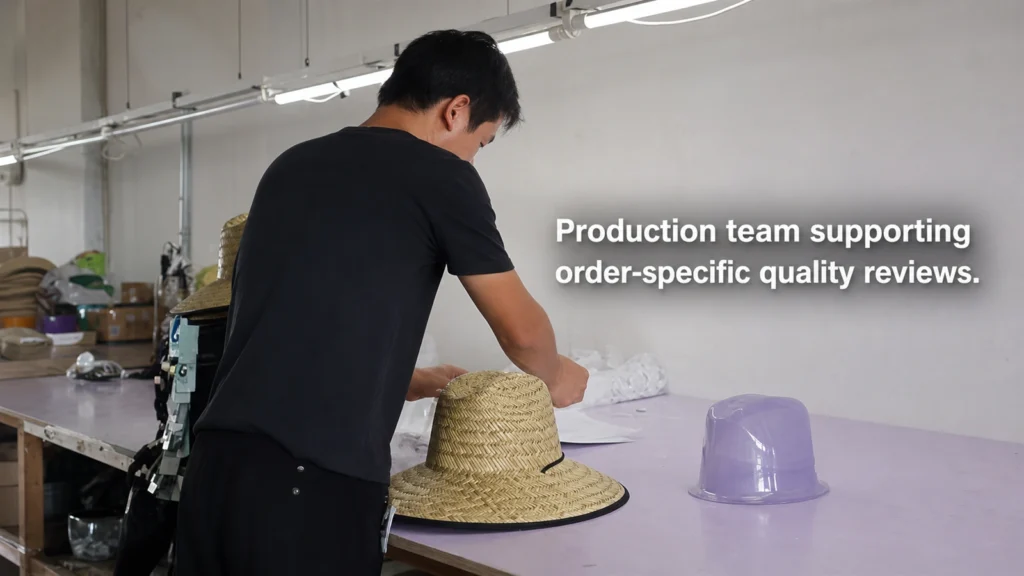
If two teams obtain conflicting results, compare their tools, landmarks, product condition and measurement path before deciding that the hats themselves differ.
For most buyer-facing specifications, the practical requirement is straightforward: identify the measured property, method, tool and result. If a program requires a formal calibration or measurement-traceability system, define that requirement separately with the quality team. NIST guidance provides background on metrological traceability; citing it does not mean that TerraHats is NIST certified or endorsed.
What Happens When a Measurement Is Out of Spec?
An out-of-spec reading should trigger a controlled review rather than an immediate assumption about the entire order:
- Isolate the measured unit and record the point, result and product condition.
- Repeat the measurement using the approved method and tool.
- Confirm that the inspector used the current specification and sample version.
- Check additional units using the agreed sampling and escalation rule.
- Identify whether the issue is isolated, systematic or linked to handling or packing.
- Agree on disposition: accept an approved deviation, segregate, rework, replace, re-inspect or escalate for buyer review.
The purchase agreement or inspection plan should define who can approve a deviation. An inspector should not silently widen the tolerance to make a result pass.
Brim Width Does Not Establish a UPF Rating
A broader brim may provide more physical shade than a narrower silhouette in some wearing conditions, but brim width alone does not establish a UPF value.
UV performance can depend on material transmission, weave openings, construction, coverage, angle, lining and the scope of applicable testing. Do not convert a wide-brim description into a UPF claim unless current evidence supports the exact claim for the stated material, component or finished product.
The dimensional specification controls size and shape. Any UV-protection claim needs a separate evidence and compliance review.
Frequently Asked Questions
What dimensions should a wide-brim hat specification include?
Common fields include the internal opening, crown height and front, side and back brim projections. Some styles may also need opening length and width, overall footprint, brim profile or decoration-position fields. Select the fields that control the actual product instead of copying a universal table.
How should brim width be measured?
Define the start point, edge point, direction, product condition and whether the path is a straight projection or follows the surface. Curved and asymmetric brims may need separate front, side and back measurements.
Where should crown height be measured?
At the landmark named in the specification. Depending on the profile, that may be the front, side, back or highest point. State the base datum and supported or relaxed condition as well.
Is head circumference the same as the hat’s internal circumference?
No. Head circumference describes the wearer; the internal opening describes the finished product. Fit decisions connect the two, but they remain separate fields with separate methods.
Is there one acceptable tolerance for all straw hats?
No universal tolerance should be assumed. Approve tolerances for the product, size, material, construction, measurement field and method.
Can a photograph be used to measure brim and crown proportions?
A controlled photograph can support shape comparison and revision comments, but perspective can distort dimensions. Use the physical product, defined tools and written method for dimensional inspection.
Should both sides of the brim be measured?
When left-right balance matters, record both sides or define a separate symmetry check. One side measurement does not prove that the opposite side matches.
Can wide-brim dimensions support a UPF claim?
Not by themselves. Brim dimensions describe shape and potential shade area; they do not establish a tested UPF rating.
Turn the Approved Shape Into a Production Reference
A style name begins the conversation. A measured specification turns the approved direction into an inspectable production reference.
For a custom wide-brim hat, identify the internal opening, crown landmark, front, side and back brim points, measurement paths, product condition and product-specific acceptance limits.
This gives product, procurement, production and quality teams the same answer to three questions:
- What is being measured?
- How is it being measured?
- Which approved result should production match?

Move from a reference image to a measurable production brief.
Send TerraHats your intended style, wearer group, target market, artwork status and available reference sample or drawing.
Request a measured product sample
You can also review wide-brim straw sun hat options and the TerraHats sample policy.
Sources and Further Reading
- DLA ASSIST — MIL-DTL-44105, Hat, Sun, Hot Weather
- ISO 18890:2018 — Clothing: Standard Method of Garment Measurement
- ISO 139:2005 — Textiles: Standard Atmospheres for Conditioning and Testing
- NIST — Metrological Traceability: FAQs and Policy
- ARPANSA — Australian Sun-Protective Clothing and Hat Requirements