-
WhatsApp +86 15116118247
-
Any Questions info@terrahats.com

Why Wide-Brim Hats Need a Defined Packing Method
See why wide-brim straw hats need order-specific nesting, support, individual packing, carton count and handling instructions.

A wide-brim hat can leave production in the approved shape and still reach the buyer with a distorted brim, compressed crown, marked trim or inconsistent retail presentation.
The problem is often not the absence of packaging. It is the absence of a defined packing method.
“Pack in export cartons” does not tell the packing team whether the hats may be nested, where support is required, which surfaces must remain clear, how many units belong in each carton, or what the buyer should see when the carton is opened. Those decisions become especially important when the product combines a large brim with a formed crown, binding, artwork, a chin cord or other shape-sensitive details.
The packing method is part of the approved product configuration whenever packing can change the hat’s delivered condition.
A useful straw hat bulk packaging specification does not promise that damage is impossible. It records an order-specific arrangement that the supplier, buyer and inspector can review against the actual hat and intended distribution route.
Table of Contents
Quick Answer: Why Do Wide-Brim Hats Need Packing Specifications?
Wide-brim hats need a defined packing method because their shape creates several connected packing decisions:
- Nesting: Whether the selected construction can be nested
- Crown and brim support: How both areas will be protected without creating new pressure points
- Separation: Whether adjacent hats or decorated surfaces need isolation
- Individual pack: What protective, labeling or presentation components belong with each unit
- Carton allocation: How the pack count affects clearance, pressure and SKU organization
- Movement control: How the hats will be restrained without loading shape-critical areas
- Shipping configuration: Which orientation, closure, carton and palletization instructions apply
- Approval evidence: What photos, tests and inspections will confirm the pack-out
These decisions should not be copied from another style without checking the actual construction, decoration and proposed pack-out. A flexible beach hat, a structured lifeguard hat and a formed straw fedora may react differently to the same carton arrangement. Some hats can be nested under an approved method; others need greater separation or a different support concept. Foldability must also be established for the specific construction rather than assumed from the product category.
Packing Is a Product Decision, Not Just a Freight Decision
Packaging has to perform two jobs at once.
First, it must support distribution: the carton needs suitable construction, closure and internal restraint for the planned handling route. General parcel-packaging guidance from UPS in the United States and FedEx’s European customer-packaging guide recommends suitable outer packaging, cushioning where appropriate and limiting movement inside the package. These are general carrier guidelines, not hat-specific specifications or validation for a bulk ocean, LTL or palletized route.
Second, the arrangement must respect the product’s geometry. For a wide-brim hat, the solution should not prevent movement by transferring excessive filling pressure onto the crown top, brim edge or another shape-critical area. That is an engineering application for hats—not a hat-specific rule published by the carriers.
Conservation guidance offers another useful design principle. The Canadian Conservation Institute recommends supporting hat crowns and brims fully without forcing them tightly into unsuitable forms. The US National Park Service says a storage support should raise the brim slightly off the shelf to prevent distortion and that hats with weak brims require full support in the crown and under the brim. Its museum-storage section also says not to stack hats. Those instructions apply to museum collections; they are not, by themselves, a universal commercial-shipping rule or a ban on an order-specific nesting method that has been evaluated for a new product.
For commercial orders, the packing team must convert that principle into a pack-out that can be assembled repeatedly, inspected and tested for the relevant route.
6 Key Decisions for Straw Hat Bulk Packaging
1. Decide Whether and How the Hats Will Nest
Nesting can reduce unused space, but “nested” is not a complete instruction.
The specification should identify:
- Stack eligibility: Which styles and sizes may share a stack
- Orientation: How every hat faces within the group
- Crown alignment: Whether crown interiors align without forcing
- Brim position: Whether brims remain level, offset or separated
- Surface contact: Whether trims, patches, cords or printed surfaces touch another unit
- End protection: How the first and last hats in the group are protected
- Removal method: How the stack will be lifted out without pulling on the brim
Do not assume that every wide-brim hat is unsuitable for nesting. Do not assume that every apparently similar crown can be nested safely either. Review the actual construction and decoration.
A trial pack should be unpacked and compared with the approved hat reference. If appearance changes after the proposed packing period or handling sequence, the buyer and supplier should agree on the acceptable delivered condition and any approved recovery procedure before bulk release.
2. Support the Crown and Protect Brim Clearance
The crown and brim should be considered as one geometry. Supporting one area badly can transfer load into another.
Depending on the construction, a proposed method may use a crown form, internal insert, brim-under support, perimeter clearance, separator or another purpose-designed component. The exact material and dimensions remain order-specific.
The engineering objective is to:
- Orientation: Maintain the intended product position
- Crown load: Prevent concentrated pressure on the crown top
- Brim load: Keep the brim from becoming the carton’s load-bearing surface
- Perimeter clearance: Avoid forcing the brim edge against the carton wall
- Surface protection: Prevent support materials from marking the straw, binding, sweatband or decoration
- Safe removal: Allow the packed group to be removed without bending a critical area
Support should be firm enough to function but not so tight that it creates a new pressure point. A component that works for one crown depth or brim profile may be unsuitable for another.
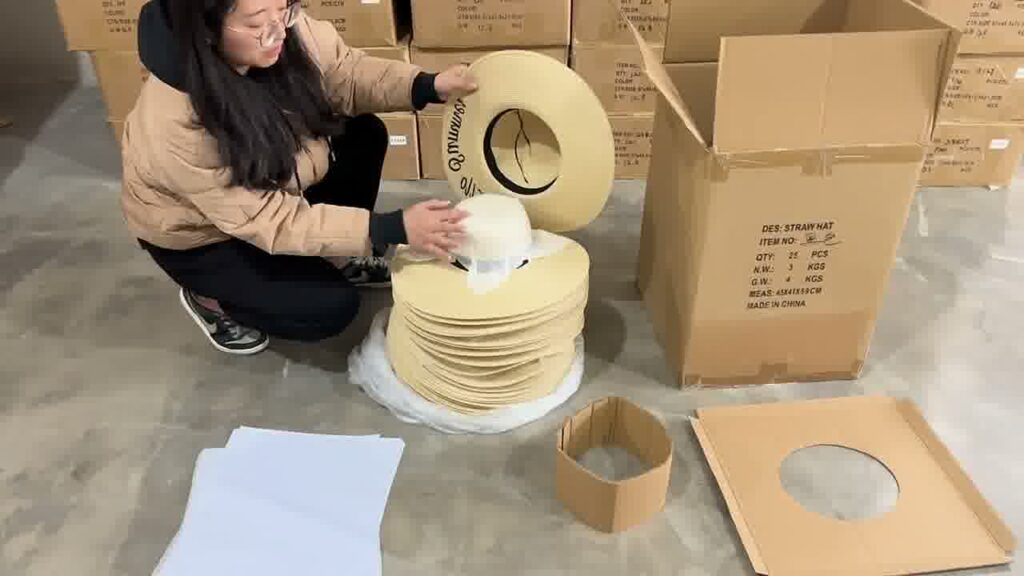
3. Define the Individual Pack
An individual pack may provide surface protection, SKU separation, presentation components or contamination control. It does not automatically provide structural protection.
Record whether each unit requires:
- A bag, tissue, sleeve or other wrap
- Venting or closure details appropriate to the selected material and route
- A crown insert or removable support
- Protection between decoration and adjacent surfaces
- Hangtags, barcodes, size labels or buyer inserts
- A specific fold or placement for chin cords
- A warning, care card or unpacking instruction approved for that construction
The individual pack must be reviewed as part of the complete carton arrangement. A bag that fits loosely on a sample table may bunch under nesting pressure. A hangtag placed correctly on one unit may mark the next brim when units are stacked.
CCI’s museum-textile guidance identifies incorrect relative humidity, pollutants and physical forces—including vibration, impact, pressure, abrasion and shocks during transit—as deterioration risks; it also notes that dust can harm fibres and that high relative humidity can promote mould and material change. This is conservation guidance for collection objects, not commercial performance data for new straw hats. In a commercial specification, relevant risks should be assessed for the product, route and storage context. Museum humidity targets should not be copied into a hat purchase order, and no universal desiccant quantity should be prescribed without order-specific packaging and environmental review.
4. Make Carton Count a Controlled Variable
Units per carton affect more than freight efficiency. Changing the count can alter stack height, internal clearance, restraint, gross weight, handling and the pressure experienced by the product.
The specification should therefore record the approved pack count together with:
- Style, color and size assortment
- Inner-pack grouping
- Carton construction and internal arrangement
- Product orientation
- Supports and separators
- Closure method
- Carton-mark content
- Palletization requirements, when applicable
No single carton count can be recommended from the product category alone. Final values depend on the hat dimensions, construction, assortment, protective method, carton choice and distribution plan.
If the quotation was based on one pack-out and the final approved product requires another, review the commercial and logistics effect before shipment.
5. Control Compression Through Evidence
Compression should not be treated as a default space-saving setting.
Some constructions may tolerate a defined amount and duration of pressure under an approved test. Others may show an unacceptable change in brim set, crown shape, edge finish or decoration. A product described as straw or wide-brim is not automatically foldable, crush resistant or able to recover after compression.
Instead of publishing a universal compression ratio or limit:
- Define the proposed pack-out.
- Identify the surfaces that will receive load.
- Pack the actual approved construction.
- Expose it to a test appropriate to the distribution route.
- Unpack and evaluate it using agreed timing, conditions and criteria.
- Record whether the method is approved, revised or rejected.
Record the evaluation checkpoints in the test plan—for example, immediately after unpacking and at one or more buyer-approved later intervals. The exact timing should be defined for the product, material, pack-out and commercial requirement rather than presented as an industry-wide recovery standard. If recovery is permitted, also record the approved resting conditions, any allowed reshaping procedure and the condition expected at each checkpoint.
ISTA distinguishes between testing contexts such as individual parcel delivery, less-than-truckload distribution and unitized full-truckload shipment. The relevant procedure should match the real route. If palletized cartons will later be separated and shipped individually, parcel exposure may also need consideration.
ISTA says that most protocols call for the Product Damage Tolerance and Package Degradation Allowance to be defined before testing. The shipper, manufacturer and other relevant stakeholders define and agree those criteria; pass/fail is then assessed against them rather than against one universal acceptable outcome.
6. Specify Handling Marks and Identification
Handling marks can communicate orientation, care or destination information, but they do not replace protective design. FedEx specifically notes that it cannot ensure compliance with marks such as “Up” arrows or “This End Up”; other care statements, including “Do Not Crush,” should likewise be treated as handling instructions rather than physical protection.
Record the marks required for the actual order, including where relevant:
- Purchase-order or shipment reference
- Style, SKU, color and size assortment
- Carton sequence
- Destination or warehouse code
- Approved orientation marks
- Buyer-required handling statements
- Scannable label or barcode requirements
- Pallet or master-carton identification
The buyer should confirm any retailer, carrier, customs or destination-specific requirements. Marks should remain consistent with the packing list and inspection record so receiving teams can trace a problem to the affected configuration.
Packing-Spec Decision Table
Use this table as a decision framework. Replace every “confirm” item with an order-specific value, method or approved reference.
| Packing decision | What the supplier should propose | What the buyer should approve | Evidence to retain |
|---|---|---|---|
| Hat identity | Style, construction, size and decoration covered by the method | Exact SKU and approved product revision | Approved sample ID and specification revision |
| Nesting | Whether nesting is proposed, orientation, grouping and contact points | Whether the actual construction and trims may be nested | Packed and unpacked trial photos |
| Crown support | Insert or support concept and contact areas | Fit without forcing, marking or crown-top loading | Side-view and crown-interior photos |
| Brim protection | Support, separator and carton-wall clearance concept | Acceptable brim position and protected edge or trim areas | Top, side and close-up photos |
| Individual pack | Bag, tissue, sleeve, insert, label and cord arrangement | Protection, presentation and data requirements | One complete unit-pack photo |
| Carton count | Proposed units and assortment per carton | Order-specific count and SKU split | Pack list and open-carton photo |
| Movement restraint | How internal movement will be limited | Restraint without concentrated pressure on shape-critical areas | Gap, support and closure photos |
| Carton and closure | Carton construction, internal fit and closing method | Suitability for the distribution plan | Closed-carton and seam photos |
| Route test | Proposed test context based on parcel, LTL or unit load handling | Damage tolerance and package-degradation allowance | Test plan, observations and disposition |
| Handling marks | Mark content, position and orientation | Buyer, destination and carrier requirements | All marked carton panels |
| Palletization | Orientation, stabilization and mixed-SKU rules where applicable | Unit-load arrangement and downstream handling plan | Pallet views and pallet record |
| Final inspection | Pack-out checks and result format | Sample selection, acceptance criteria and response to variance | Packing inspection report |

Approval-Photo Checklist
Packing approval photos should make the arrangement reproducible. Attractive product photos alone are not enough.
Request a dated, order-linked set showing:
- The unpacked approved hat from the front, side and top
- The individual bag, tissue, insert, labels and other unit components
- The crown interior before and after support is fitted
- The brim position and any under-brim support or separator
- Contact points between adjacent hats when nesting is proposed
- Clearance between the product and carton walls
- The first layer or group placed in the carton
- The complete open-carton pack-out before closure
- The carton closure method
- Every panel carrying carton marks or labels
- The carton after the agreed handling or distribution test
- The hats immediately after unpacking
- The hats again at the agreed evaluation point, if recovery time is part of the method
- Close-ups of any change in crown, brim, binding, trim, print or surface
- The approval decision, revision date and authorized packing-spec reference
Photos should use enough light and consistent angles to make comparison possible. They support the written specification; they do not replace carton data, test conditions or approval records.

Common Packing Mistakes
Copying Another Hat’s Carton Specification
Similar-looking hats can differ in brim stiffness, crown depth, edge construction, trims and response to pressure. Start with the approved product, not a previous carton count.
Treating Nesting as a Yes-or-No Attribute
Nesting depends on orientation, stack arrangement, contact areas, protection and the actual construction. Define the method rather than writing only “nested.”
Filling Empty Space by Pressing on the Product
Internal movement should be limited, but excessive fill or a tightly forced carton can transfer pressure to the brim or crown. Review the load path as well as the visible empty space.
Assuming the Individual Bag Protects the Shape
A bag may help with surface cleanliness and unit organization. Structural support and carton restraint are separate decisions.
Approving the Hat but Not the Pack-Out
A loose sample does not approve a bulk carton configuration. When delivered shape or presentation matters, include packing in the sample approval process.
Changing Carton Count After Approval
A different count can change clearance, weight, movement and pressure. Treat the change as a packing-spec revision and review it before release.
Using Handling Marks as the Main Protection
Marks communicate instructions but cannot substitute for suitable carton construction, restraint, clearance and route-appropriate validation.
Promising Damage-Free Delivery
A defined method can reduce avoidable packing risk and make inspection more consistent. It cannot eliminate every effect of handling, storage or transportation.
How Buyers Can Approve a Packing Method
A practical approval sequence is:
- Lock the product sample, dimensions, construction, decoration and labels.
- Tell the supplier how the shipment will move and how cartons will be received or redistributed.
- Request a packing proposal covering nesting, supports, separation, individual packing, count, carton, closure, marks and palletization.
- Review a packed trial using the approval-photo checklist.
- Define acceptable product condition and package degradation before route testing.
- Test the proposed configuration against the relevant distribution context.
- Record the approved method as a controlled specification.
- Verify the same configuration during final packing inspection.
- Apply change control if the product, count, carton, route or protective materials change.
Buyers sourcing wide-brim straw sun hats or wholesale lifeguard straw hats should expect the final method to vary by construction and program. The product page can define the style direction; the order record must define the pack-out.
Frequently Asked Questions
Can all wide-brim straw hats be nested?
No universal answer applies. Some approved constructions may be nested using a defined orientation and protection method. Others may need separation or additional support because of the crown, brim, binding, trim or decoration. Review a trial pack for the actual SKU.
Should wide-brim hats always be packed individually?
Individual packing may be useful for surface protection, labeling, SKU control or retail presentation, but it is not automatically required for every order. It also does not replace structural support. Decide it according to the product, sales channel and distribution requirements.
How many wide-brim hats should go in one carton?
There is no fixed carton quantity suitable for every style. The count must be confirmed with the hat dimensions, structure, assortment, supports, carton construction, handling route and approved delivered condition.
Can a carton compress wide-brim hats to reduce freight volume?
Only if the specific construction and proposed method have been reviewed and validated against agreed criteria. Do not assume that a straw hat is foldable or that it will recover automatically. Avoid publishing a universal compression ratio or recovery promise.
What should a straw hat bulk packaging specification include?
At minimum, identify the SKU and revision, orientation, nesting or separation method, crown and brim support, clearances, individual pack, carton count, assortment, carton construction, closure, handling marks, palletization where applicable, inspection method and retained evidence.
Do “This Side Up” or “Do Not Crush” marks prevent damage?
No. They communicate handling intent but cannot guarantee carrier behavior. Use them as one part of a complete method that also addresses product support, internal movement, carton construction and distribution testing.
Should packing be approved with the sample?
It should be reviewed when packing can affect delivered shape, decoration, labeling or retail presentation. The product sample and packing trial may be reviewed in stages, but both should be linked to the final approved order configuration before bulk shipment.
Does one successful parcel test approve palletized or LTL distribution?
Not necessarily. Parcel, less-than-truckload and unit-load systems can create different handling exposures. Select testing that reflects the actual route, including any downstream change from palletized transport to individual parcel delivery.
Confirm the Pack Before Bulk Release
Wide-brim hat packing should end with a controlled decision, not a warehouse assumption.
Share the selected hat, dimensions, decoration, size assortment, order structure, receiving method and distribution route. Use these details to request an order-specific review of nesting, support, individual packing, carton organization and approval evidence.
Explore wholesale hat manufacturing and confirm an order-specific packing plan, or contact TerraHats with the product reference and packing requirements for your program.

Sources and Further Reading
- Canadian Conservation Institute — Storage for Costume Accessories
- National Park Service — Museum Handbook, Part I, Appendix K: Curatorial Care of Textile Objects
- Canadian Conservation Institute — Textiles and the Environment
- UPS — Packaging Tips
- FedEx Europe — Customer Packaging Guidelines (March 2023)
- ISTA — Test Procedures
- ISTA — Getting Started With Design
- ISTA — Who Determines Pass or Fail of Testing Results?