Why Amazon Sellers Should Stop Copying the Same Paddle Spec
Copying the same paddle specs can make Amazon listings look replaceable. Brands need clearer positioning, packaging and QC.

Many Amazon sellers start a private-label pickleball paddle project by collecting the same spec list they see everywhere else.
Carbon fiber surface. 16mm thickness. Honeycomb core. Comfortable grip. Premium feel. USAPA-ready wording. Giftable packaging. Maybe a trendy shape, a long handle, or a thermoformed structure.
None of those choices are automatically wrong. Some of them may be the right choices for a strong product. The problem is that copied specs often create copied listings.
If five sellers ask a factory for almost the same paddle, the final products may look different only in logo, color, and box design. From a buyer’s point of view, the listings become easy to compare and easy to replace. That is a weak position for any Amazon seller who wants better reviews, stronger brand memory, and more repeatable sourcing.
At VortexPaddle, we believe Amazon sellers should stop treating paddle specs as a feature checklist. A better private-label paddle starts with a buyer promise, then connects that promise to material, shape, thickness, packaging, quality control, and reorder consistency.
Table of Contents
The Factory View: A Copied Spec Usually Creates a Copied Listing
A paddle specification should describe how the product is built. An Amazon listing has a different job. It must explain why a buyer should choose this product instead of the next similar paddle on the page.
When sellers copy the same spec, the listing language usually becomes the same too:
- Premium carbon fiber surface.
- Great control and power.
- Comfortable ergonomic grip.
- Durable edge guard.
- Suitable for beginners and advanced players.
- Ideal gift for pickleball players.
Those claims are familiar because they are broad. They may be true in a general way, but they do not create a clear reason to buy one brand over another.
The factory can manufacture a paddle from a copied feature list. But if the seller has no product angle, the sample process becomes a race to make “something like the market.” That is not the same as building a private-label product with a defendable position.
Copycat Spec vs Differentiated SKU
| Decision Area | Copycat Spec Thinking | Differentiated SKU Thinking |
|---|---|---|
| Target buyer | “Pickleball players” | Beginner, intermediate, control player, power player, club buyer, gift buyer, or premium buyer |
| Product promise | “High quality paddle” | A specific reason to choose the paddle, such as control comfort, power response, starter-set value, or premium feel |
| Material | Choose the same popular material name | Choose the material that supports the buyer promise and price tier |
| Thickness | Follow the common number | Match thickness to playing feel, channel, and product role |
| Shape | Copy a popular shape | Use shape and handle length to support the intended use case |
| Packaging | Add a nice box after the spec is chosen | Plan packaging, labels, inserts, set contents, and protection early |
| QC | Approve one good sample | Define a repeatable inspection standard for future orders |
| Reorder | Treat the first order as the main goal | Build a SKU that can be reordered with consistent quality and story |
The better question is not “What paddle spec is selling now?” It is “What product promise can our brand own, and what specification supports that promise?”
Why Identical Specs Make Amazon Products Easier to Replace
Amazon shoppers compare quickly. They look at images, price, reviews, rating patterns, delivery expectations, brand signals, and whether the product seems made for their need.
If several listings use the same claims and similar visuals, the seller loses room to explain real value. The product becomes easy to judge by price, coupon, delivery date, or a small difference in reviews.
That is the danger of copying a paddle spec. The seller may believe they are reducing risk by following the market, but they may also be removing the product’s reason to exist.
A private-label paddle should not be different only because the logo is different. It should have a clearer buyer fit:
- A forgiving control paddle for newer players who want stability.
- A power-oriented paddle for buyers who want a more direct response.
- A premium carbon fiber paddle for a more technical product line.
- A fiberglass or hybrid paddle for value sets, clubs, and starter programs.
- A custom artwork paddle for brand campaigns, team programs, or gift channels.
- A bundle SKU with balls, bag, grips, or edge protection for a fuller purchase.
These directions do not require every product to become complex. They require the seller to decide what the paddle is supposed to do in the product line.
Start With the Buyer Promise, Then Choose the Spec
Many sellers reverse the process. They choose the surface, thickness, core, shape, handle, grip, and packaging first. Then they try to turn those details into a listing story.
That often leads to generic copy.
The stronger route is to define the buyer promise first:
| Buyer Promise | Specification Direction to Discuss With the Factory |
|---|---|
| Easy control for improving players | Stable thickness, comfortable weight range, balanced feel, clear control-focused copy |
| More responsive power feel | Shape, structure, weight range, and surface choices that support a stronger response |
| Premium technical product | Carbon fiber or other premium surface direction, process discussion, QC focus, restrained claims |
| Beginner or family set | More approachable material choice, accessory bundle, easy packaging, durable presentation |
| Club or school program | Repeatability, comfort range, replacement planning, simple packaging, bulk order logic |
| Giftable private-label product | Visual design, packaging, insert card, bundle layout, and clear audience positioning |
Once the promise is clear, the specification becomes easier to judge. A feature is useful when it supports the promise. It is noise when it only makes the listing sound like everyone else’s.
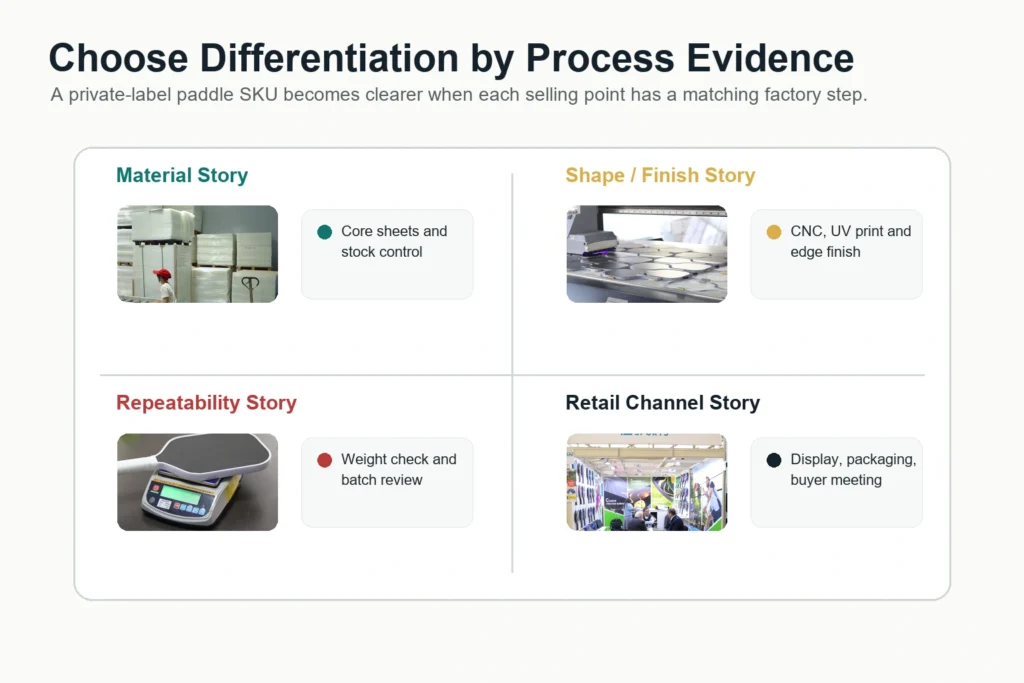
Material Names Do Not Create Differentiation by Themselves
Material labels are important, but they can become shortcuts.
A carbon fiber pickleball paddle can support a premium or performance-oriented story. A fiberglass pickleball paddles direction can still make sense for value lines, club programs, starter sets, or broader wholesale needs. A thermoformed pickleball paddle can be a strong product when the process fits the target buyer and product tier.
But no material label automatically creates differentiation.
If every seller says “carbon fiber surface” without explaining buyer fit, feel, QC, packaging, or product role, the listing still looks replaceable. The same is true for 16mm, honeycomb core, edgeless design, long handle, raw texture, or any other common feature.
The factory conversation should go deeper than the material name:
- What buyer is this material serving?
- What price and product tier should it support?
- What surface feel and appearance should the sample prove?
- What weight range and balance should be controlled?
- What claim can the seller make honestly and consistently?
- What should stay the same when the product is reordered?
That is how material choice becomes part of a real SKU strategy.
Packaging Is Part of the Product, Not a Last Step
Amazon sellers often focus on the paddle first and packaging later. That can create problems because packaging affects both the buyer experience and the operational plan.
Packaging can influence:
- First impression in product images.
- Brand trust after delivery.
- Protection during handling and fulfillment.
- Barcode and label planning.
- Set configuration with balls, bags, grips, or edge tape.
- Insert cards, care instructions, and reorder messaging.
- Carton marks and shipment organization.
If packaging is added only after sample approval, the seller may need to adjust artwork, set contents, box size, labeling, or product images late in the project.
For a private-label Amazon paddle, packaging should be part of the original brief. It does not need to be fully designed on day one, but the factory should know whether the seller is planning a single paddle, a set of two, a giftable box, a club bundle, or a retail-style presentation.
Reviews Depend on Repeatability, Not Only the First Sample
Amazon sellers usually understand that reviews matter. But review stability starts before the product is live.
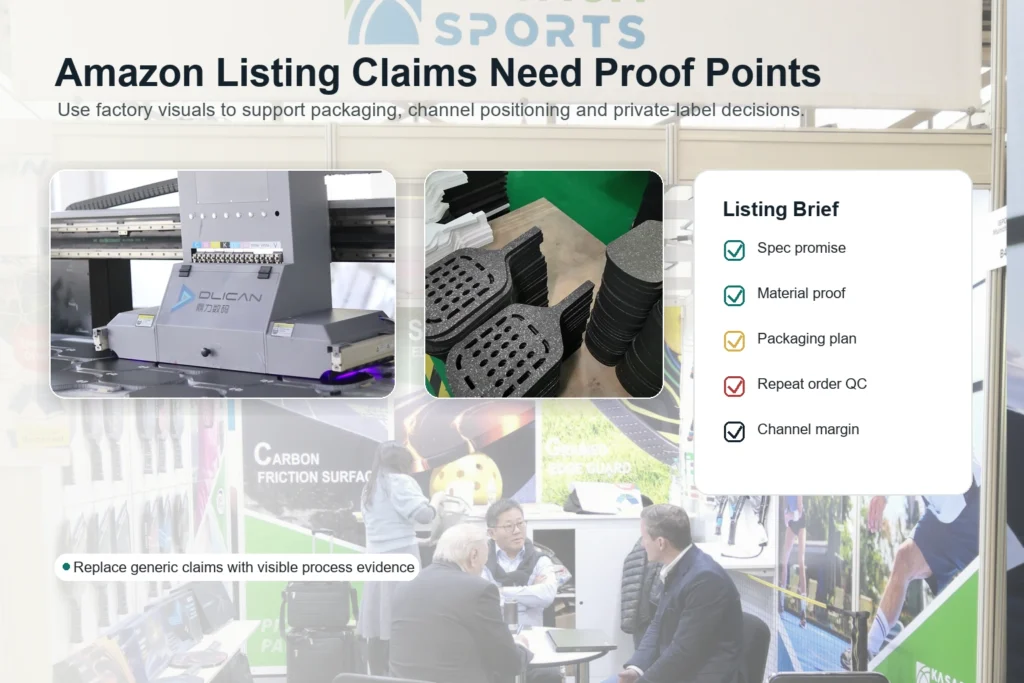
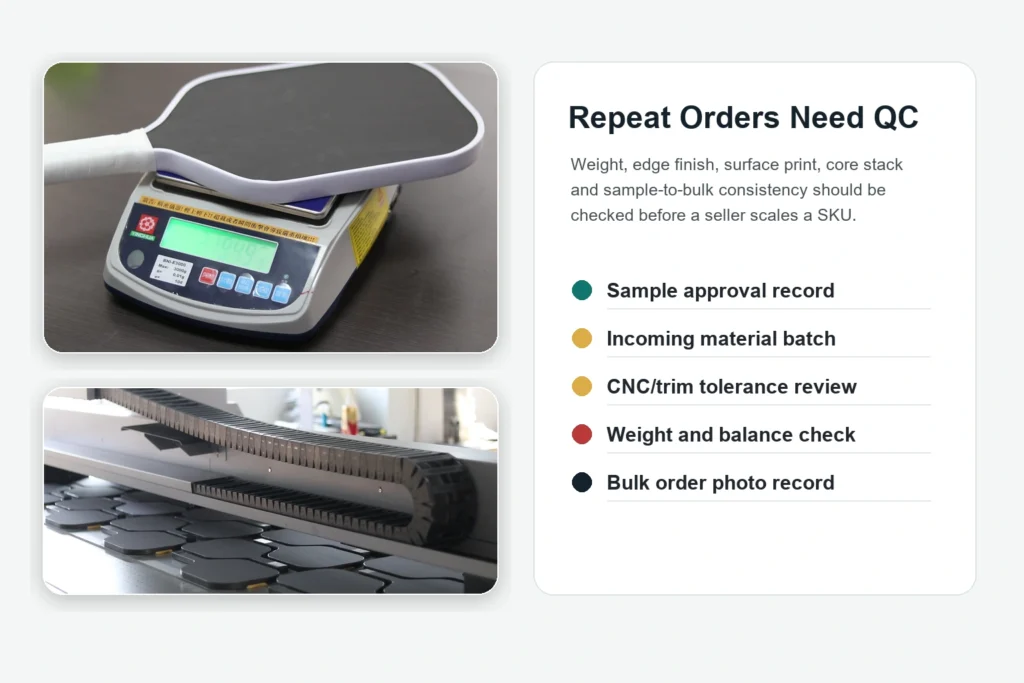
If a seller approves one good sample but does not define repeatable standards, future orders may drift in ways that customers notice: weight feel, surface appearance, edge finish, grip wrapping, packaging quality, logo placement, or accessory consistency.
This is why quality control should not be treated as a final inspection formality. It should be part of the private-label product plan.
A stronger brief should define:
| QC Area | What to Clarify Before Bulk Production |
|---|---|
| Weight and balance | Target range, acceptable tolerance, and sample reference |
| Surface appearance | Texture, print clarity, finish, and acceptable visual variation |
| Edge and structure | Edge guard fit, edgeless finish, handle connection, and visible defects |
| Grip | Grip type, wrap quality, comfort, and consistency |
| Artwork | Logo placement, color reference, front / back design, and proof approval |
| Packaging | Box, insert, labels, barcode, carton marks, and protection standard |
| Reorder control | Which approved sample, files, and specifications should be reused |
For sellers, repeatability protects more than quality. It protects the listing promise. A product that changes too much from batch to batch can weaken review consistency and make reorders harder to manage.
OEM and ODM Sellers Need Different Briefs
Not every Amazon seller needs the same development path.
An OEM pickleball paddles project is usually better when the seller already has a clearer target specification, artwork direction, packaging idea, and product positioning. The factory helps manufacture and refine that defined direction.
An ODM pickleball paddles project can be better when the seller needs help choosing from factory models, adjusting material, logo, color, packaging, or product role.
The mistake is asking for ODM-style recommendation while also expecting OEM-level precision and speed. If the seller only says “make the popular spec,” the factory can offer options, but the product may still lack a clear listing angle.
| Seller Situation | Better Development Route |
|---|---|
| Has target spec, artwork, and packaging direction | OEM sample development |
| Has a brand idea but needs model recommendation | ODM model selection and adjustment |
| Wants to enter Amazon quickly with a private-label paddle | Start with ODM, but define buyer promise and packaging first |
| Wants a unique product line | OEM brief with specification, artwork, QC, and reorder plan |
| Wants to test several buyer groups | Build one hero SKU and one supporting SKU before expanding |
The right route helps the seller avoid turning sample development into a guessing game.
USAPA-Ready Wording Should Not Be a Sticker
Some Amazon sellers want to use USAPA-related language because it sounds credible. That topic should be handled carefully.
USAPA-related planning is not just a marketing phrase. It can involve eligible specifications, dimensions, surface, weight, sample consistency, and official submission requirements. Final approval depends on formal review by the relevant governing body, so a seller should not treat every private-label design as automatically approved.
VortexPaddle can support paddle development for official USAPA approval requirements and assist brands through the official certification process when eligible specifications are required.
For Amazon sellers, the practical point is simple: discuss USAPA-ready development before artwork, packaging, listing claims, and launch timing are locked. Do not add approval language at the end if the product was not planned around those requirements from the beginning.
A Better Brief for Amazon Private-Label Paddle Projects
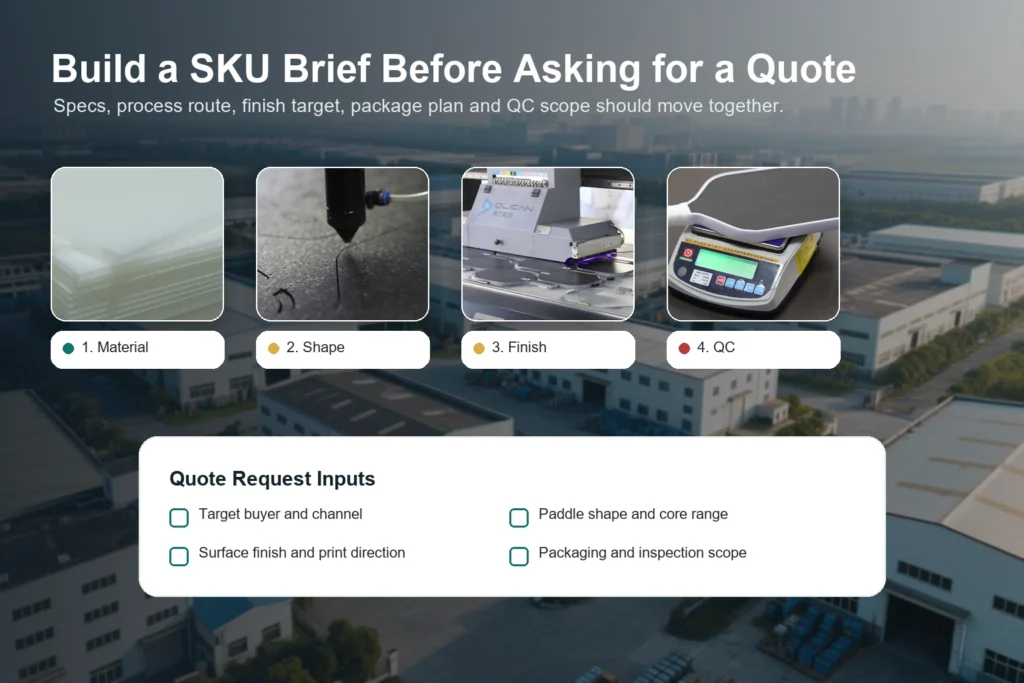
Before requesting samples, Amazon sellers should prepare a short but specific product brief.
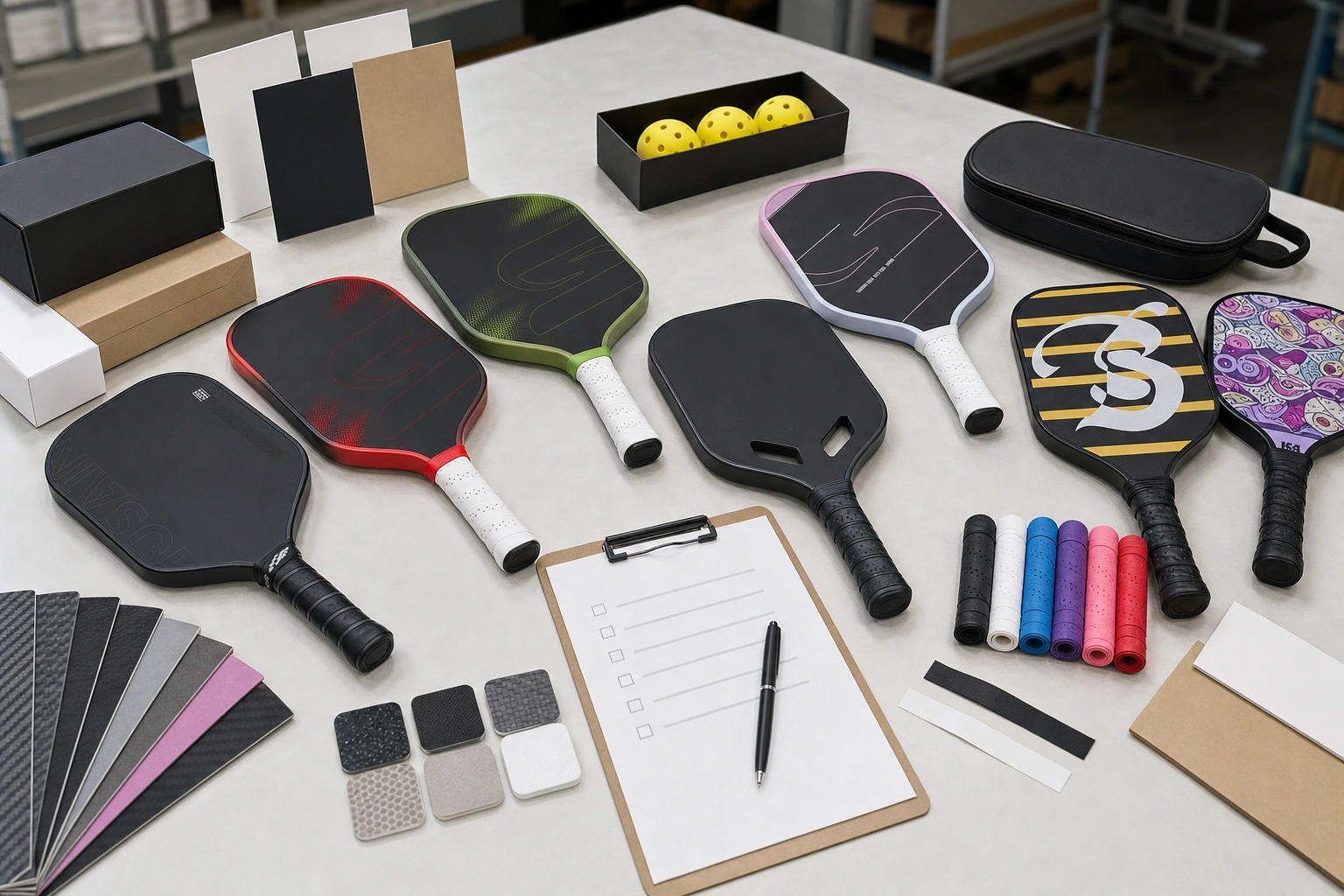
Use this checklist:
- Target buyer: beginner, intermediate, control player, power player, gift buyer, club buyer, or another clear group.
- Product promise: the main reason a shopper should choose this paddle.
- Sales format: single paddle, paddle set, starter kit, gift box, or bundle with accessories.
- Preferred material direction: carbon fiber, fiberglass, hybrid surface, or factory recommendation.
- Thickness, shape, handle, edge style, and weight range if already known.
- Reference products, including what should be similar and what should be different.
- Artwork files, logo placement, color expectations, and print method needs.
- Packaging direction, label needs, inserts, barcode planning, and carton requirements.
- QC priorities, especially weight, surface, grip, edge finish, packaging, and reorder consistency.
- Compliance-related needs, including whether USAPA-ready development support is required.
This brief gives the factory a stronger starting point than a copied competitor spec. It also helps the seller evaluate samples based on business purpose, not only on whether the paddle looks like a current market trend.
What Amazon Sellers Should Copy Instead
Sellers should stop copying the same paddle spec, but they can copy a better process.
Copy the discipline of defining a buyer. Copy the habit of testing samples against a clear promise. Copy the practice of planning packaging before launch assets are built. Copy the discipline of approving realistic QC standards before bulk production. Copy the idea of building one strong hero SKU before adding too many variants.
That is the kind of copying that helps a private-label product become stronger.
The goal is not to make every paddle unusual. The goal is to make every specification choice useful.
The VortexPaddle Point of View
Amazon sellers do not need a paddle that is different for no reason. They need a paddle that is different in the ways buyers can understand, reviewers can experience, and factories can repeat.
A copied spec may feel safe at the start, but it can create a product that is easy to replace. A focused private-label SKU gives the seller more control over product story, packaging, sample review, quality standards, and future reorders.
The best factory conversation is not:
“Can you make the same paddle as this listing?”
It is:
“Can you help us build a paddle specification that supports our buyer, listing promise, packaging plan, and reorder standard?”
That shift is where private-label paddle development becomes more strategic.
Get Quote
If you are planning an Amazon private-label paddle line, VortexPaddle can help you compare OEM and ODM routes, material options, sample development, packaging, QC requirements, and USAPA-ready development needs.
Start with your target buyer, listing promise, preferred specification direction, artwork files, packaging plan, and expected reorder needs. Then request a quote built around a product strategy, not only a copied feature list.
FAQ
Why should Amazon sellers avoid copying the same pickleball paddle spec?
Copying the same spec can make the product and listing look replaceable. A private-label paddle should connect the specification to a clear buyer promise, packaging plan, quality standard, and reorder strategy.
Is carbon fiber always the best paddle material for Amazon sellers?
No. Carbon fiber can support a premium or performance-oriented product, but the best material depends on the target buyer, price tier, product promise, packaging plan, and QC expectations.
Should Amazon sellers choose OEM or ODM pickleball paddles?
OEM is usually better when the seller has a clearer specification, artwork, and packaging direction. ODM is useful when the seller needs factory model recommendations and selected customization before building a private-label SKU.
What should be included in an Amazon private-label paddle brief?
Include the target buyer, product promise, sales format, material direction, shape, thickness, handle, artwork, packaging, QC priorities, reorder expectations, and any USAPA-ready development requirements.
Why does packaging matter for Amazon pickleball paddles?
Packaging affects first impression, protection, barcode and label planning, bundle layout, insert cards, product images, and fulfillment readiness. It should be discussed before bulk production, not only after the paddle sample is approved.
Can VortexPaddle help with USAPA-ready paddle development?
Yes. VortexPaddle supports paddle development for official USAPA approval requirements and can assist brands through the official certification process when eligible specifications are required. Final approval depends on formal submission and review.