Why T700 Raw Carbon Fiber Became a Buyer Shortcut and Where It Can Mislead Brands
A factory view on why T700 raw carbon fiber became a quick buyer signal, and why brands still need process, QC, surface, and SKU context.

T700 raw carbon fiber has become one of the easiest words for pickleball paddle buyers to trust.
For a brand owner, Amazon seller, distributor, or procurement manager, the phrase sounds efficient. It suggests a more technical paddle, a premium surface story, a modern product page, and a specification that buyers may already recognize from competing listings.
That is why many custom paddle projects now begin with a simple request:
“Can you make a T700 raw carbon fiber paddle?”
The request is not wrong. A T700 carbon fiber pickleball paddle can be a strong product direction when the buyer wants a premium material story, a control-oriented or performance-oriented SKU, and a more technical private-label paddle.
But the material name is only a shortcut. It is not the full product.
For B2B buyers, the better question is not “Is T700 good?” It is “Does this T700 surface direction fit the target buyer, paddle structure, surface finish, compliance path, QC standard, packaging plan, and reorder strategy?”
That is where the shortcut becomes useful. It is also where it can mislead brands.
Table of Contents
The Factory View: T700 Is a Material Signal, Not a Complete Specification
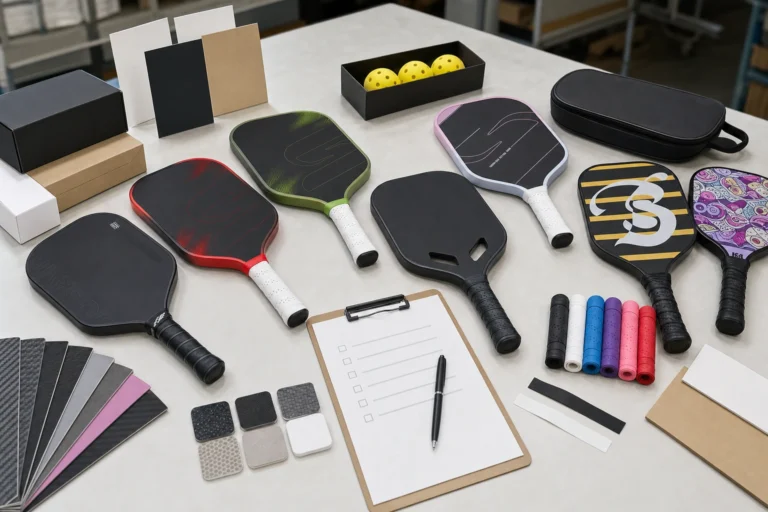
T700 helps buyers speak quickly about a carbon fiber surface direction. That is useful in early sourcing because it narrows the conversation. It tells the factory that the buyer is not asking for a basic fiberglass starter paddle or a generic low-end custom paddle.
But a pickleball paddle is not defined by surface material alone.
The final product depends on the complete structure:
- Surface material and weave or surface appearance.
- Surface texture, coating, paint, or finishing method.
- Core type and thickness.
- Thermoformed, cold pressed, foam-enhanced, or other process direction.
- Shape, handle length, grip, and edge construction.
- Weight range and balance feel.
- Artwork method and logo placement.
- Packaging protection and retail presentation.
- Compliance needs and claims discipline.
- QC checkpoints for sample approval and bulk production.
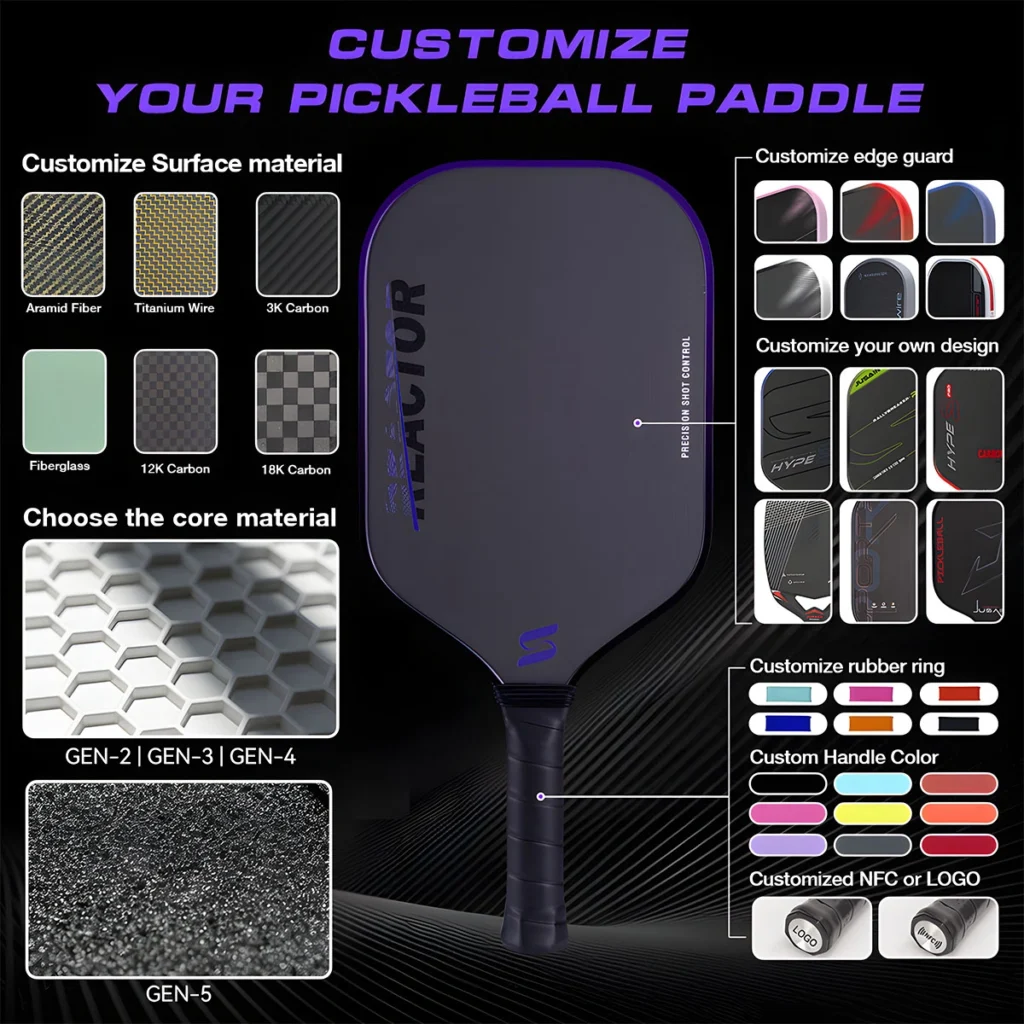
The local VortexPaddle product archive supports multiple T700-related directions, including T700 UD surface references, T700 3K surface references, thermoformed references, PP honeycomb core references, 13.5mm to 16mm thickness directions, long-handle options, Gen 3 and Gen 4 core references, and several entries that still require factory confirmation before strong claims should be used.
That is exactly the point: T700 can sit inside many different paddle designs. The label does not decide the SKU by itself.
Why T700 Became a Buyer Shortcut
T700 became a shortcut because it solves several buyer problems at the inquiry stage.
First, it gives buyers a recognizable material term. Instead of saying “premium paddle surface” or “high quality carbon fiber,” the buyer can point to a specific carbon fiber direction and sound more prepared.
Second, it supports product-page language. “T700 raw carbon fiber” is easier to explain than a long manufacturing conversation about surface finish, resin system, roughness control, core response, and batch inspection.
Third, it gives sellers a way to separate a performance SKU from a lower-cost recreational paddle. In a product line that includes fiberglass, custom logo paddles, training paddles, and carbon fiber models, T700 can help mark a more premium tier.
Fourth, it creates a faster quote conversation. When a buyer says T700, the factory can start discussing compatible molds, core directions, thickness, process, surface finish, and artwork methods more quickly.
Those benefits are real.
The problem starts when the buyer treats T700 as proof that the paddle is already well designed.
T700 as a Shortcut vs T700 as a Product Decision
| Decision Area | When the T700 Shortcut Helps | Where It Can Mislead |
|---|---|---|
| Early inquiry | Quickly signals a carbon fiber direction | Can hide missing decisions about buyer, channel, and product role |
| Product positioning | Supports a premium or technical paddle story | Can make every listing sound the same if the story stops at material |
| Sampling | Helps the factory choose relevant surface samples | Does not define core, thickness, weight range, shape, or process |
| Surface feel | Gives buyers a starting point for texture discussion | Does not guarantee a specific spin, control, or power result |
| Compliance planning | Identifies a material direction to test and document | Does not automatically satisfy surface, size, approval, or listing requirements |
| Bulk production | Can become part of a repeatable spec | Fails if surface texture, coating, weight, and finish are not controlled |
A good factory treats T700 as the start of the conversation. A weak brief treats it as the whole conversation.
The Biggest Misunderstanding: Raw Carbon Fiber Is Not Just a Marketing Phrase
Many buyers use “raw carbon fiber” as if it simply means premium.
In real product development, raw carbon fiber language usually points to surface feel, texture, appearance, and the way the paddle face interacts with the ball. That makes it important, but also risky to oversimplify.
The surface must still be controlled. If texture is too vague, the sample may feel good once but become difficult to repeat. If the coating or finish changes during bulk production, the buyer may receive a paddle that looks similar but plays differently. If artwork covers or changes the intended surface effect, the product story can weaken. If the surface is described too aggressively, the brand may create compliance or credibility risk.
The USA Pickleball Equipment Standards Manual does not approve a paddle because it uses a certain material name. It includes requirements around paddle material, hitting surface, roughness and friction measurements, reflection, size, model designation, approval listing, and ongoing compliance. It also states that there is no restriction on paddle thickness, while other requirements still apply.
For brands, that means the surface discussion should be specific:
- What is the intended surface texture?
- Is the artwork method compatible with that texture?
- Which finish or coating will be used?
- What roughness and friction expectations must be checked?
- What should remain consistent from sample to bulk order?
- Will the product need USAPA-ready development support?
T700 may be the chosen surface direction. It should not replace surface control.
T700 Does Not Automatically Define Control, Power, or Spin
T700 is often connected with control, spin, premium feel, or technical performance in market language. Those associations can be useful, but they should stay qualified.
A T700 paddle can be designed for control. It can be designed for a faster, more responsive feel. It can support a premium carbon fiber product story. It can also become a generic SKU if the rest of the brief is weak.
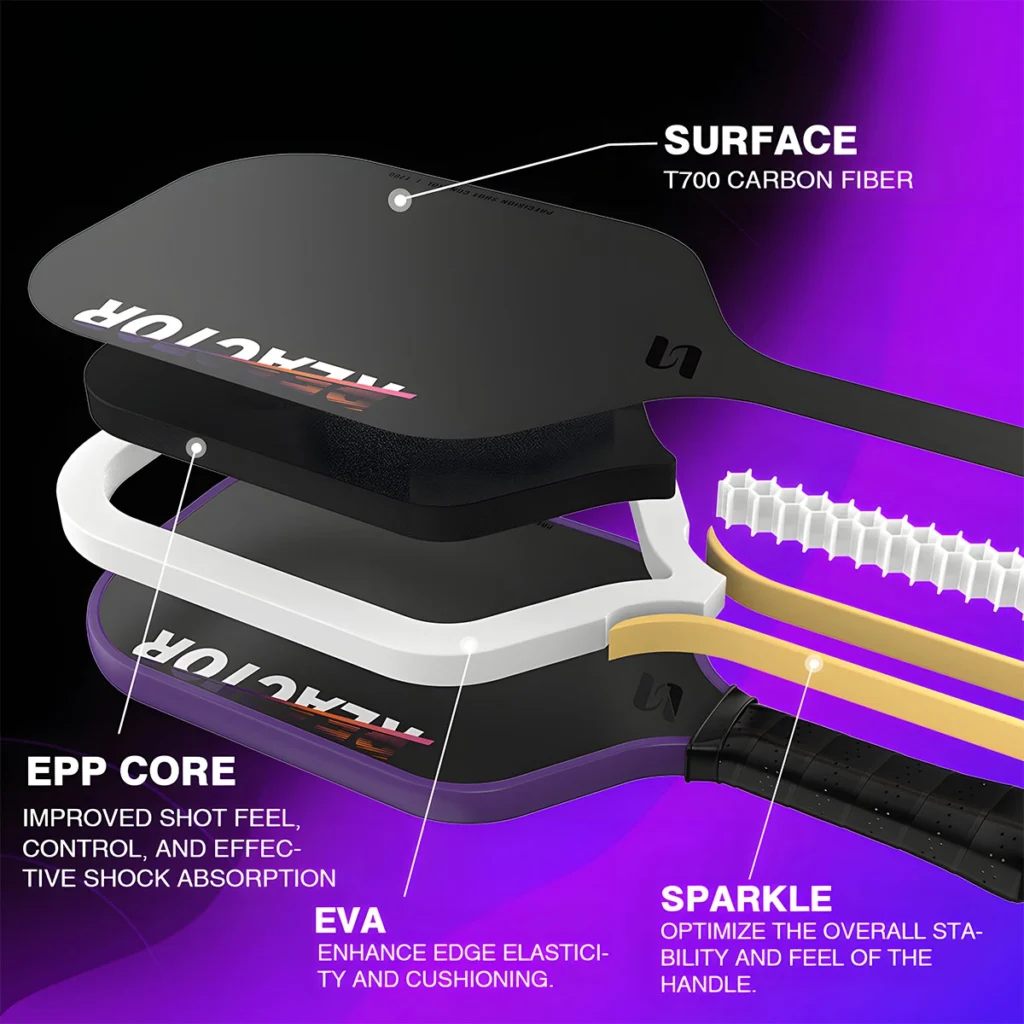
Performance perception depends on the full paddle system:
- A 16mm control-oriented build will not feel the same as a thinner, faster-feeling build.
- A thermoformed paddle will not behave like every cold pressed paddle.
- A long handle changes the buyer profile and product story.
- A foam-enhanced core may create a different response from a standard PP honeycomb core.
- Surface finish, coating, and artwork can affect the buyer’s perception of the face.
- Weight range and balance can change the feel even when the material label stays the same.
That is why a brand should avoid saying “T700 equals control” or “T700 equals spin” without explaining the structure that supports the claim.
Better product copy connects the material to a specific SKU promise:
- T700 carbon fiber control paddle for a stable, placement-focused product line.
- T700 thermoformed paddle for a premium technical SKU.
- T700 long-handle paddle for players who prefer two-handed backhand options.
- T700 custom paddle for a brand that wants a stronger material story with controlled artwork and packaging.
Material plus role is stronger than material alone.
Where T700 Can Mislead Brand Owners
T700 can mislead brands in five common ways.
1. It Can Make the Buyer Skip Positioning
Some buyers choose T700 before they define the target customer.
That creates a problem. A paddle for Amazon performance shoppers is not the same as a paddle for club programs, school purchasing, distributor catalogs, specialty retail, or premium brand-owned ecommerce.
If the buyer cannot explain who the paddle is for, T700 becomes decoration. The product may look technical, but the SKU has no clear job.
2. It Can Make the Product Line Too Repetitive
If every model uses the same T700 story, the product line becomes flat.
A strong line may need a T700 control SKU, a fiberglass value SKU, a thermoformed premium SKU, a custom logo program, or a power-oriented model with different thickness and handle choices. If every listing says “T700 raw carbon fiber” without a different buyer promise, the brand still looks replaceable.
3. It Can Hide Process Differences
A T700 surface can appear in different process directions. Thermoformed, cold pressed, foam-core, edgeless, edge-guard, 14mm, 16mm, long-handle, and standard-shape projects should not be treated as the same product only because the surface label matches.
Process affects sample review, QC, packaging protection, reorder consistency, and product explanation.
4. It Can Create Unsupported Performance Claims
Buyers sometimes want to turn T700 into a strong claim too quickly: more spin, more power, better control, professional feel, or tournament-ready performance.
Some of those messages may be appropriate after sample testing and compliance review. But as default copy, they can overclaim. A safer approach is to connect claims to tested sample feel, surface control, target buyer, and approved wording.
5. It Can Distract From Bulk Production Control
The first T700 sample may look and feel excellent. That is only the beginning.
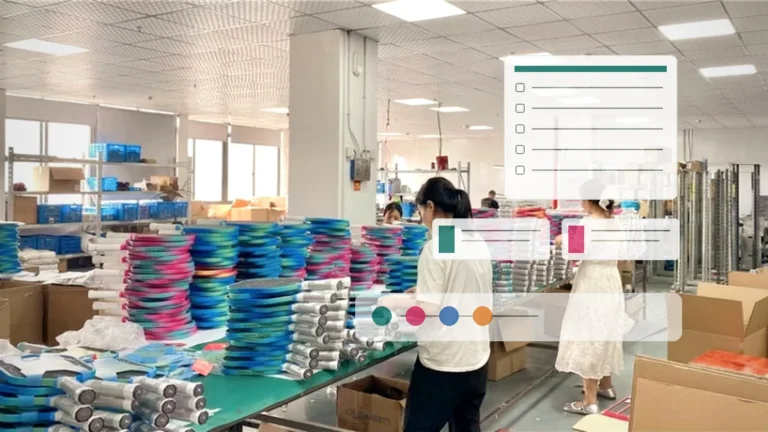
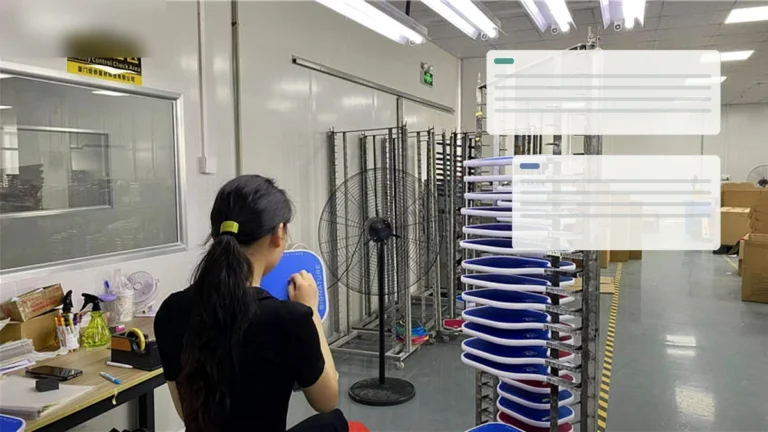
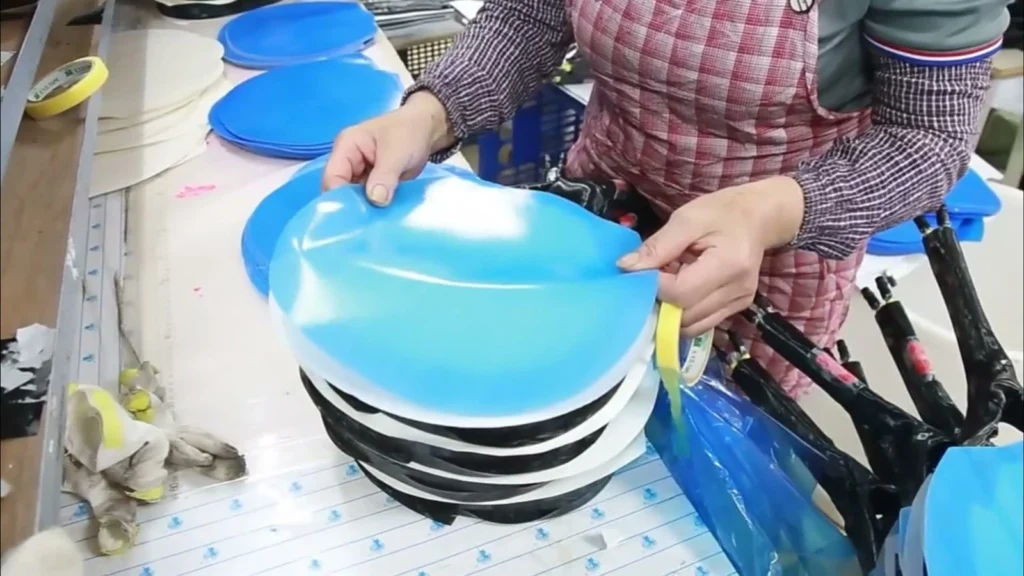
The approved sample must become a repeatable production standard. The factory and buyer should define acceptable ranges for weight, balance, surface appearance, texture, edge finish, handle, grip, artwork, and packaging.
Without that standard, a strong sample can become an inconsistent reorder.
How T700 Fits Different SKU Roles
T700 is most useful when it is assigned a clear job in the product line.
| SKU Role | How T700 May Fit | What the Buyer Should Clarify |
|---|---|---|
| Premium control SKU | Supports a carbon fiber control story when paired with suitable thickness, shape, and core | Target buyer, control promise, weight range, surface finish, and QC method |
| Technical hero SKU | Can support a more advanced product page when paired with thermoformed or other premium construction | Process, core, edge structure, sample feel, and compliance needs |
| Amazon private-label SKU | Gives the listing a recognizable material hook | Differentiation beyond the material name, packaging, images, and review consistency |
| Distributor line | Can serve as the premium option above value paddles | Reorder stability, account fit, simple explanation, and price tier |
| Custom logo paddle | Adds a stronger material story to branded projects | Artwork method, surface coverage, color limits, logo placement, and packaging |
| Power or faster-feel SKU | May fit if thickness, core, shape, and balance support the role | Avoid assuming T700 alone creates power; verify through samples |
This is the better way to use T700: as one choice inside SKU architecture.
QC Questions Buyers Should Ask Before Approving a T700 Sample
Before approving a T700 raw carbon fiber paddle sample, buyers should ask practical production questions:
- What exact surface direction is being used: UD, 3K appearance, raw texture, coated finish, or another factory-confirmed option?
- How will surface texture and appearance be checked in bulk production?
- What core, thickness, shape, handle length, and edge structure are paired with the surface?
- What weight range and balance feel should be repeated?
- Will the artwork method change the surface feel or visual quality?
- What inspection standard will be used before shipment?
- What packaging is needed to protect the surface and edge finish?
- Does the project need USAPA-ready development support?
- Which claims are safe to use before official approval or public listing is confirmed?
These questions are not extra bureaucracy. They protect the brand from turning a material shortcut into a production problem.
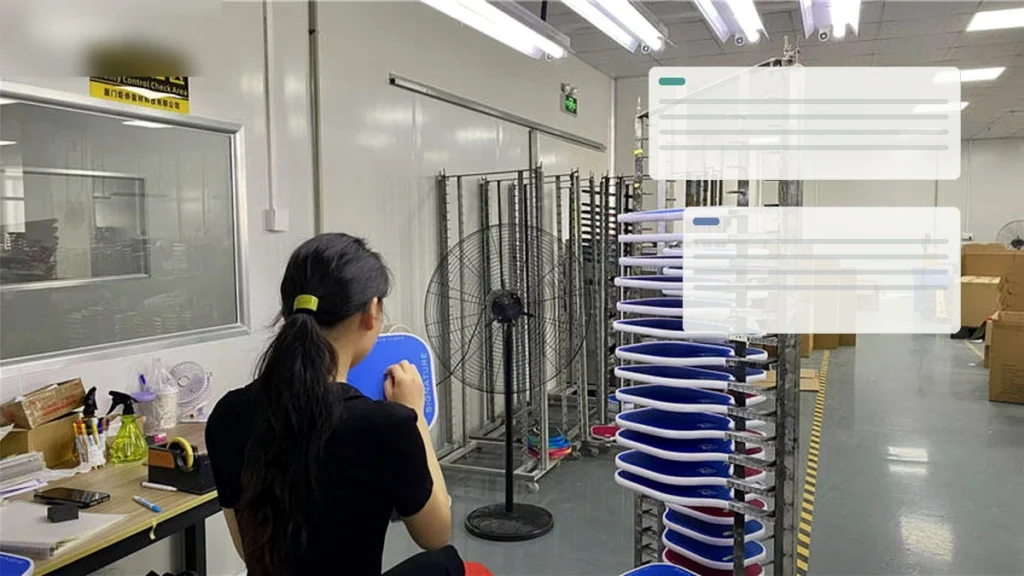
A Better Brief for T700 Raw Carbon Fiber Paddle Samples
Instead of asking only for a T700 raw carbon fiber paddle, buyers should prepare a sample brief that connects the material to the business goal.
A useful brief should include:
- Target buyer: beginner, improving player, advanced player, club, school, distributor, Amazon shopper, or retail customer.
- Product role: control SKU, power SKU, premium hero SKU, value line, custom logo project, or supporting model.
- Sales channel: Amazon, distributor, retail, club program, school purchasing, promotional order, or brand-owned ecommerce.
- Material direction: T700 raw carbon fiber, T700 UD, T700 3K appearance, standard carbon fiber, fiberglass, Kevlar, or factory recommendation.
- Construction direction: thermoformed, cold pressed, foam-core, PP honeycomb, edgeless, edged, or factory-confirmed option.
- Thickness and shape: 14mm, 16mm, elongated, standard, long handle, wide body, or mold reference.
- Surface and artwork needs: texture, coating, logo method, color coverage, and packaging design.
- Compliance needs: USAPA-ready development support if the paddle will be submitted for official approval.
- QC expectations: weight range, surface consistency, edge finish, handle/grip standard, print alignment, and packaging inspection.
- Reorder plan: what must remain identical when the brand places the second or third order.
This brief helps the factory compare real options instead of simply quoting the most familiar material phrase.
USAPA-Ready Development Should Stay Separate From Material Hype
Some buyers assume that a premium surface material makes a paddle more approval-ready. That is not the right way to think about compliance.
The official USA Pickleball Equipment Standards Manual describes paddle requirements across material safety, non-compressible construction, hitting surface limits, roughness and friction testing, reflection, size, model designation, approval listing, and ongoing compliance. It also notes that approved products must be listed in the public database to be legal for sanctioned events.
So T700 does not create approval by itself. Neither does raw texture, thermoformed construction, 16mm thickness, or any other single feature.
VortexPaddle can support paddle development for eligible specifications and help brands prepare samples with official approval requirements in mind. Final approval depends on the complete paddle specification, testing, formal submission, and public listing by the relevant governing body.
That wording matters. It keeps the brand credible.
The VortexPaddle Point of View
T700 raw carbon fiber became a buyer shortcut because it is useful. It helps buyers communicate a premium material direction quickly, supports a stronger carbon fiber product story, and gives factories a clearer starting point than vague requests for “high quality” paddles.
But it can mislead brands when it replaces real product planning.
T700 does not decide the buyer. It does not decide the channel. It does not decide control, power, spin, approval, packaging, or reorder consistency on its own.
The stronger question is:
“What kind of T700 paddle should this brand build for this buyer, channel, product promise, and production standard?”
That question leads to better samples, clearer product pages, more disciplined claims, and more reliable bulk production.
Request T700 Carbon Fiber Paddle Samples
If you are planning a T700 raw carbon fiber pickleball paddle, VortexPaddle can help compare material, surface, thickness, core, process, artwork, packaging, and QC options before sampling.
Share your target buyer, sales channel, product role, preferred surface direction, core and thickness needs, artwork plan, compliance expectations, and reorder goals. Then request samples that make T700 part of a complete product strategy, not just a material label.
Request T700 Carbon Fiber Paddle Samples
FAQ
Is T700 raw carbon fiber always better for pickleball paddles?
No. T700 raw carbon fiber can support a premium or technical paddle direction, but it is not automatically better for every buyer. The right choice depends on target customer, channel, surface finish, core, thickness, process, QC, and compliance needs.
Why do buyers ask for T700 raw carbon fiber paddles?
Buyers ask for T700 because it is a recognizable carbon fiber material direction and gives a product page a stronger technical story. It also helps factories narrow the sample discussion faster than vague requests for a premium paddle.
Does T700 raw carbon fiber guarantee more spin or control?
No single material label guarantees spin or control. Surface texture, finish, core, thickness, shape, weight range, process, and sample testing all affect how the paddle feels and how it should be described.
Is T700 better than fiberglass for every brand?
No. T700 may fit premium carbon fiber or performance-oriented SKUs. Fiberglass can still fit value lines, school or club programs, starter sets, promotional projects, and broader wholesale needs.
Does T700 raw carbon fiber guarantee USA Pickleball approval?
No. USA Pickleball approval depends on the complete paddle specification, testing, formal submission, and public listing. T700 is only one material direction and does not create approval by itself.
What should buyers include in a T700 paddle sample request?
Include target buyer, sales channel, product role, surface direction, core, thickness, shape, handle length, edge style, artwork method, packaging plan, compliance needs, QC checkpoints, and reorder expectations.